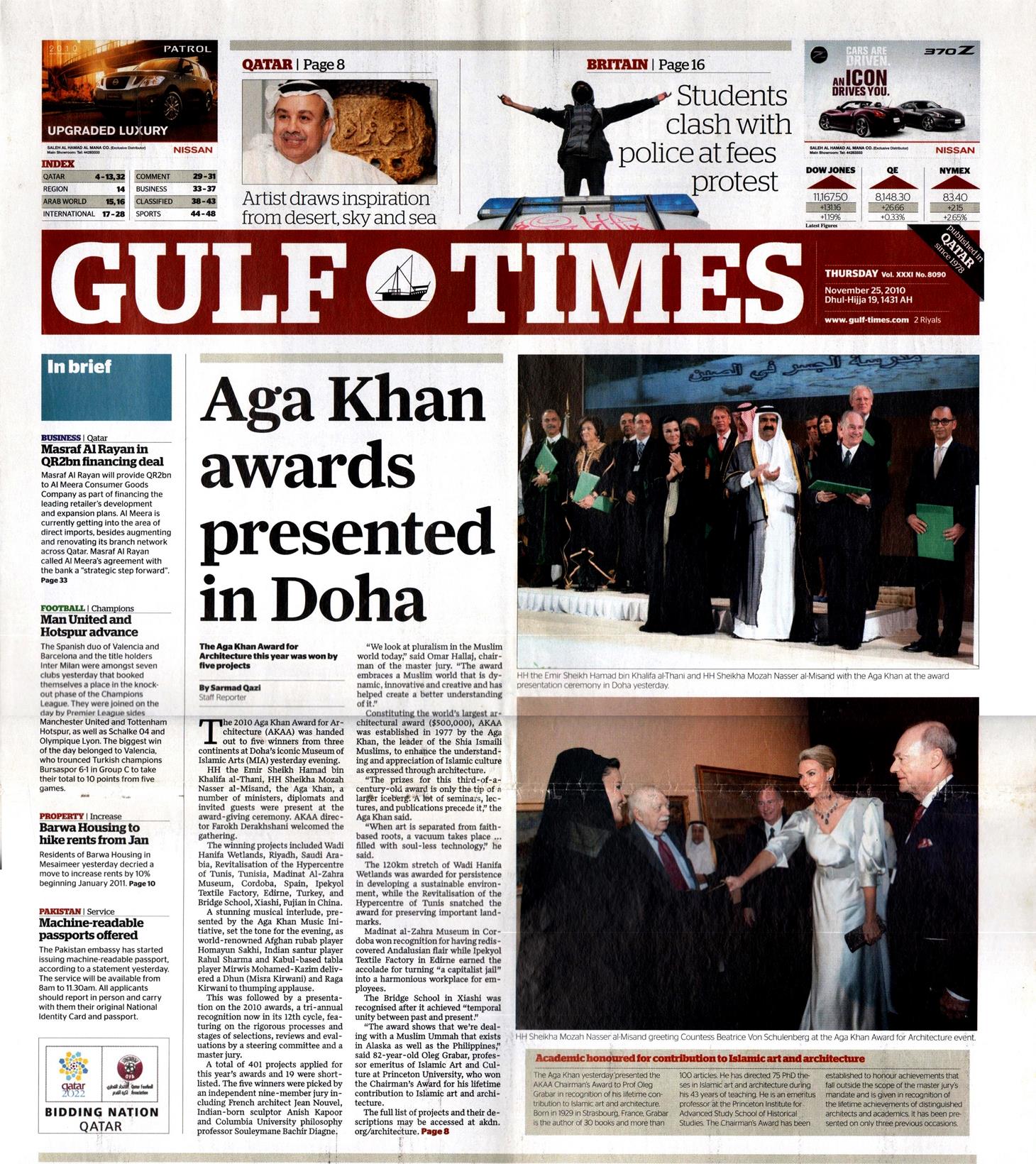
Aga Khan awards presented in Doha
Originally published in Gulf Times on November 25, 2010
The 2010 Aga Khan Award for Architecture (AKAA) was handed out to five winners from three continents at Doha’s iconic Museum of Islamic Arts (MIA) yesterday evening.
HH the Emir Sheikh Hamad bin Khalifa al-Thani, HH Sheikha Mozah Nasser al-Misand, the Aga Khan, a number of ministers, diplomats and invited guests were present at the award-giving ceremony. AKAA director Farokh Derakhshani welcomed the gathering.
The winning projects included Wadi Hanifa Wetlands, Riyadh, Saudi Arabia, Revitalisation of the Hypercentre of Tunis, Tunisia, Madinat Al-Zahra Museum, Cordoba, Spain, Ipekyol Textile Factory, Edirne, Turkey, and Bridge School, Xiashi, Fujian in China.
A stunning musical interlude, presented by the Aga Khan Music Initiative, set the tone for the evening, as world-renowned Afghan rubab player Homayun Sakhi, Indian santur player Rahul Sharma and Kabul-based tabla player Mirwis Mohamed-Kazim delivered a Dhun (Misra Kirwani) and Raga Kirwani to thumping applause.
This was followed by a presentation on the 2010 awards, a tri-annual recognition now in its 12th cycle, featuring on the rigorous processes and stages of selections, reviews and evaluations by a steering committee and a master jury.
A total of 401 projects applied for this year’s awards and 19 were shortlisted. The five winners were picked by an independent nine-member jury including French architect Jean Nouvel, Indian-born sculptor Anish Kapoor and Columbia University philosophy professor Souleymane Bachir Diagne.
“We look at pluralism in the Muslim world today,” said Omar Hallaj, chairman of the master jury. “The award embraces a Muslim world that is dynamic, innovative and creative and has helped create a better understanding of it.”
Constituting the world’s largest architectural award ($500,000), AKAA was established in 1977 by the Aga Khan, the leader of the Shia Ismaili Muslims, to enhance the understanding and appreciation of Islamic culture as expressed through architecture.
“The prizes for this third-of-a-century-old award is only the tip of a larger iceberg. A lot of seminars, lectures, and publications precede it,” the Aga Khan said.
“When art is separated from faith-based roots, a vacuum takes place … filled with soul-less technology,” he said.
The 120km stretch of Wadi Hanifa Wetlands was awarded for persistence in developing a sustainable environment, while the Revitalisation of the Hypercentre of Tunis snatched the award for preserving important landmarks.
Madinat al-Zahra Museum in Cordoba won recognition for having rediscovered Andalusian flair while Ipekyol Textile Factory in Edirne earned the accolade for turning “a capitalist jail” into a harmonious workplace for employees.
The Bridge School in Xiashi was recognised after it achieved “temporal unity between past and present.”
“The award shows that we’re dealing with a Muslim Ummah that exists in Alaska as well as the Philippines,” said 82-year-old Oleg Grabar, professor emeritus of Islamic Art and Culture at Princeton University, who won the Chairman’s Award for his lifetime contribution to Islamic art and architecture.
The full list of projects and their descriptions may be accessed at akdn.org/architecture.
As Published