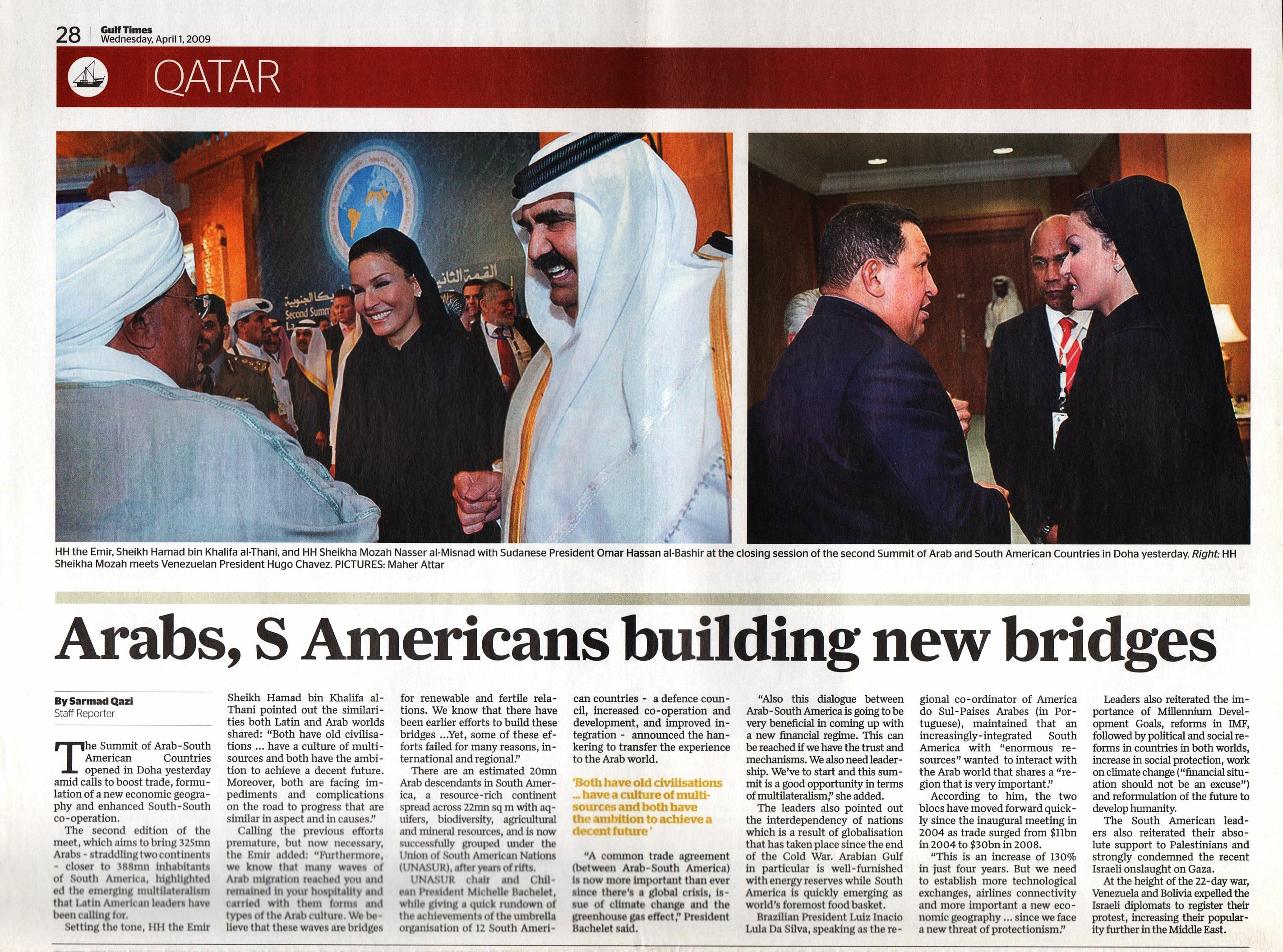
Arabs, S Americans building new bridges
Originally published in Gulf Times on April 1, 2009
The Summit of Arab-South American countries opened in Doha yesterday amid calls to boost trade, formulation of a new economic geography and enhanced South-South co-operation.
The second edition of the meet, which aims to bring 350mn Arabs straddling two continents closer to 380mn inhabitants of South America, highlighted the emerging multilateralism that Latin American leaders have been calling for.
Setting the tone, HH the Emir Sheikh Hamad bin Khalifa al-Thani pointed out the similarities both Latin and Arab worlds shared. “Both have old civilisations … have a culture of multi-sources and both have the ambition to achieve a decent future. Moreover, both are facing impediments and complications on the road to progress that are similar in aspect and in causes.”
Calling the previous efforts premature, but now necessary, the Emir added: “Furthermore, we know that many waves of Arab migration reached you and remained in your hospitality and carried with them forms and types of the Arab culture. We believe that these waves are bridges for renewable and fertile relations. We know that there have been earlier efforts to build these bridges … Yet, some of those efforts failed for many reasons, international and regional.”
There are an estimated 20mn Arab descendants in South America, a resource different in spread across 22mn sq m with aquifers, biodiversity, agriculture and mineral resources, and is now peacefully grouped under the Union of South American Nations (UNASUR), after years of rifts.
UNASUR chair and Chilean President Michelle Bachelet, while giving a quick rundown of the achievement of the umbrella organisation of 12 South American countries - a defence council, increased co-operation and development, and improved integration - announced the hankering to transfer the experience to the Arab world.
“Both have old civilisations … have a culture of multi-sources and both have the ambition to achieve a decent future”
“A common trade agreement (between Arab-South America) is now more important than ever since there’s a global crisis, issue of climate change and the greenhouse gas effect,” President Bachelet said.
“Also this dialogue between Arab-South America is going to be very beneficial in coming up with a new financial regime. This can be reached if we have the trust and mechanisms. We also need leadership. We’ve to start and this summit is a good opportunity in terms of multilateralism,” she added.
The leaders also pointed out the interdependency of nations which is a result of globalisation that has taken place since the end of the Cold War. Arabian Gulf in particular is well-furnished with energy resources while South America is quickly emerging as world’s foremost food basket.
Brazilian President Luiz Inacio Lula Da Silva, speaking as the regional co-ordinator of America do Sul-Paises Arabs (in Portuguese), maintained that an increasingly-integrated South America with “enormous resources” wanted to interact with the Arab world that shares a “region that is very important.”
According to him, the two blocs have moved forward quickly since the inaugural meeting in 2004 as trade surged from $11bn in 2004 to $30bn in 2008.
“This is an increase of 130% in just four years. But we need to establish new technological exchanges, airlines connectivity and more important a new economic geography … since we face a new threat of protectionism.”
Leaders also reiterated the importance of Millennium Development Goals, reforms in IMF, followed by political and social reforms in countries in both worlds (“elimination should not be an excuse”) and reformulation of the future to develop humanity.
The South American leaders also reiterated their absolute support to Palestinians and strongly condemned the recent Israeli onslaught on Gaza.
At the height of the 22-day war, Venezuela and Bolivia expelled the Israeli diplomats to register their protest, increasing their popularity further in the Middle East.
As Published