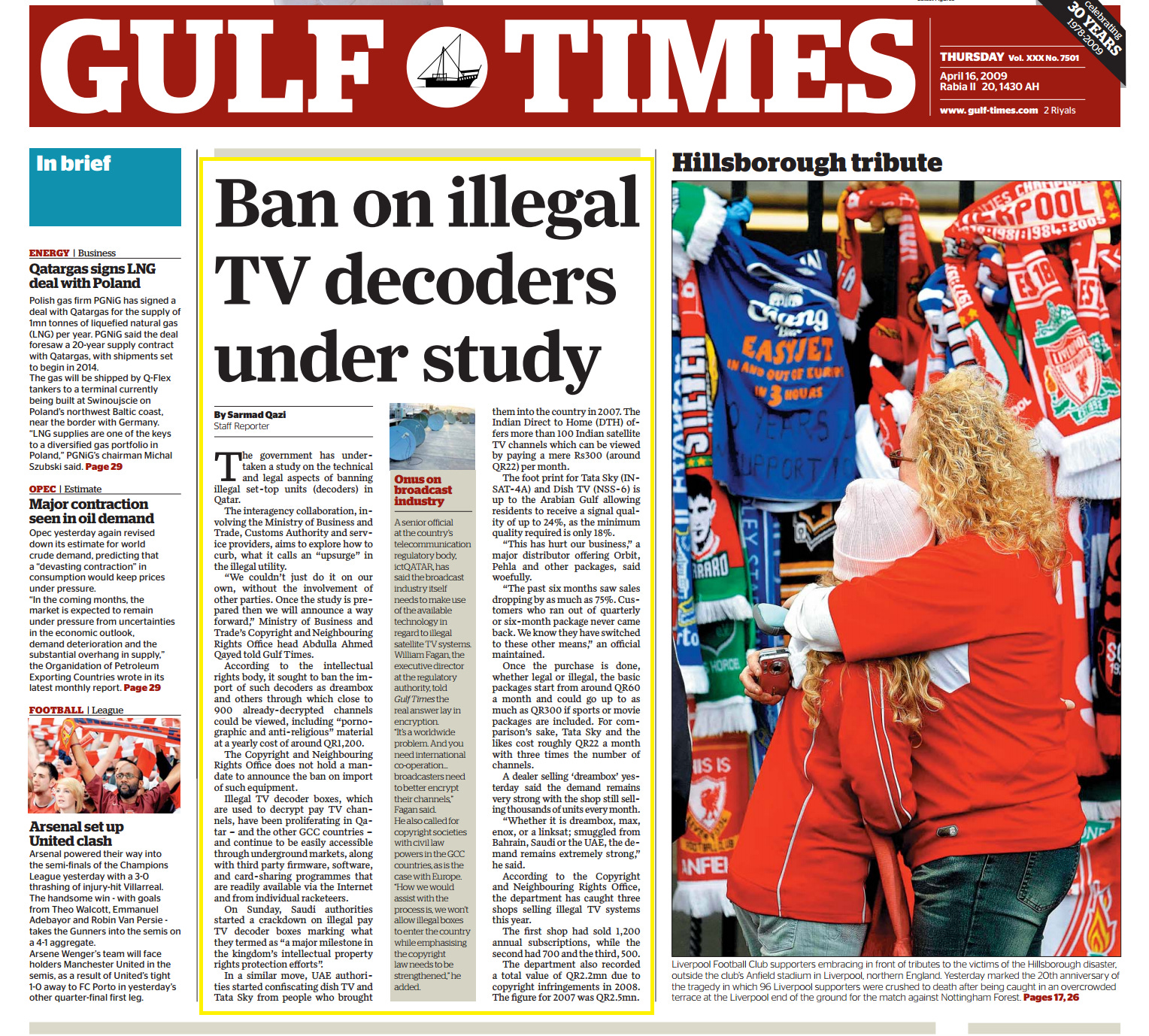
Ban on TV decoders under study
Originally published in Gulf Times on April 16, 2009
The government has undertaken a study on the technical and legal aspects of banning illegal set-top units (decoders) in Qatar.
The interagency collaboration, involving the Ministry of Business and Trade, Customs Authority and service providers, aims to explore how to curb, what it calls an “upsurge” in the illegal utility.
“We couldn’t just do it on our own, without the involvement of other parties. Once the study is prepared then we will announce a way forward,” Ministry of Business and Trade’s Copyright and Neighbouring Rights Office head Abdulla Ahmed Qayed told Gulf Times.
According to the intellectual rights body, it sought to ban the import of such decoders as dreambox and others through which close to 900 already-decrypted channels could be viewed, including “pornographic and anti-religious” material at a yearly cost of around QR1,200.
The Copyright and Neighbouring Rights Office does not hold a mandate to announce the ban on import of such equipment.
Illegal TV decoder boxes, which are used to decrypt pay TV channels, have been proliferating in Qatar – and the other GCC countries – and continue to be easily accessible through underground markets, along with third party firmware, software, and card-sharing programmes that are readily available via the Internet and from individual racketeers.
On Sunday, Saudi authorities started a crackdown on illegal pay TV decoder boxes marking what they termed as “a major milestone in the kingdom’s intellectual property rights protection efforts”.
In a similar move, UAE authorities started confiscating dish TV and Tata Sky from people who brought them into the country in 2007.
The Indian Direct to Home (DTH) offers more than 100 Indian satellite TV channels which can be viewed by paying a mere Rs300 (around QR22) per month. The foot print for Tata Sky (INSAT-4A) and Dish TV (NSS-6) is up to the Arabian Gulf allowing residents to receive a signal quality of up to 24%, as the minimum quality required is only 18%.
“This has hurt our business,” a major distributor offering Orbit, Pehla and other packages, said woefully.
“The past six months saw sales dropping by as much as 75%. Customers who ran out of quarterly or six-month package never came back.
We know they have switched to these other means,” an official maintained. Once the purchase is done, whether legal or illegal, the basic packages start from around QR60 a month and could go up to as much as QR300 if sports or movie packages are included.
For comparison’s sake, Tata Sky and the likes cost roughly QR22 a month with three times the number of channels. A dealer selling ‘dreambox’ yesterday said the demand remains very strong with the shop still selling thousands of units every month.
“Whether it is dreambox, max, enox, or a linksat; smuggled from Bahrain, Saudi or the UAE, the demand remains extremely strong,” he said.
According to the Copyright and Neighbouring Rights Office, the department has caught three shops selling illegal TV systems this year. The first shop had sold 1,200 annual subscriptions, while the second had 700 and the third, 500.
The department also recorded a total value of QR2.2mn due to copyright infringements in 2008. The figure for 2007 was QR2.5mn.
[Sidebar] Onus on broadcast industry
A senior official at the country’s telecommunication regulatory body, ictQATAR has said the broadcast industry might again be needs to make use of the available technology in regards to the satellite TV systems.
William Fagan the executive director at the regulatory authority told Gulf Times the real answer lay in encryption:
“It is a worldwide problem. And you need international co-operation… broadcasters need to better encrypt their channels,” Fagan said.
He also called for copyright societies with tough law powers in the GCC countries as is the case with Europe.
“This would assist with the initiative and allow illegal boxes to enter the country while keeping the copyright aspects to be strengthened,” he added.
As Published