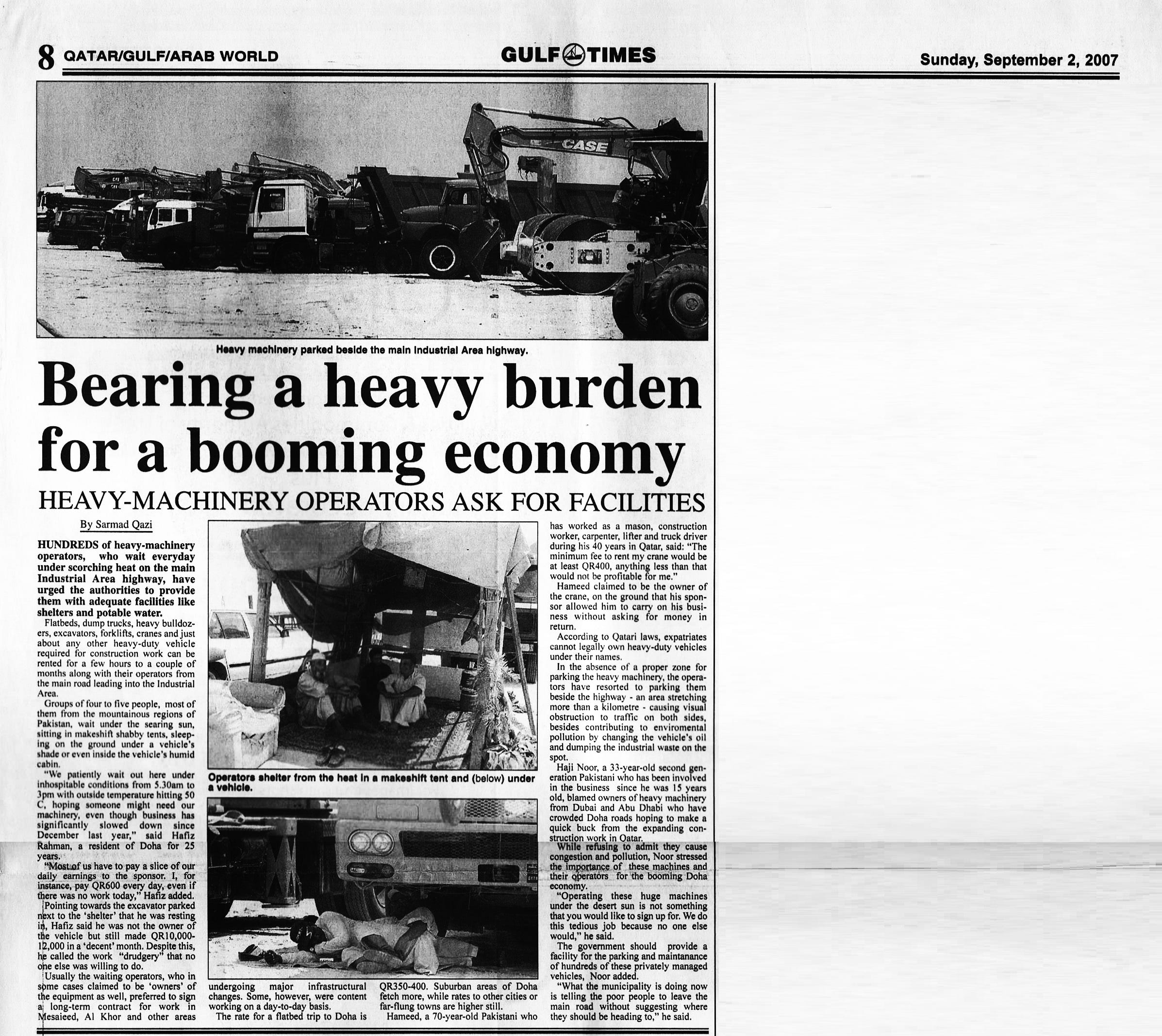
Bearing a heavy burden for a booming economy
Originally published in Gulf Times on September 2, 2007
HEAVY-MACHINERY OPERATORS ASK FOR FACILITIES
HUNDREDS of heavy-machinery operators, who wait everyday under scorching heat on the main Industrial Area highway, have urged the authorities to provide them with adequate facilities like shaded parking and water.
Flatbeds, dump trucks, heavy bulldozers, excavators, forklifts, cranes and just about any other heavy-duty vehicle required for construction work can be rented for a few hours to a couple of months along with their operators from the main road leading into the Industrial Area.
Groups of four to five people, most of them from the mountainous regions of Pakistan, can be seen sitting or lying, sitting in makeshift shabby tents, sleeping on the ground under a vehicle’s shade or even inside the vehicle’s humid cabin.
“We patiently wait out here under inhumane conditions from 6:30am to 7pm in outside temperatures hitting 50 C, hoping someone might need our machinery, even though business has significantly slowed down since Ramadan is approaching,” said Abdul Rahman, a resident of Doha for 25 years.
“Most of us have to pay a slice of our daily earnings to the sponsor. I, for instance, pay QR600 every day, even if there are no work orders,” Hafiz added.
Pointing towards the excavator parked next to the “shelter” that he was renting to a party, said he was making QR3,000 a day while the vehicle he still made QR1,000-12,000 in a decent month. Despite this, he called the work “drudgery” that no one else was willing to do.
Usually the waiting operators, who in some cases claimed to be ‘owners’ of the equipment as well, preferred to sign a long-term contract for work in Mesaieed, Al Khor and other areas undergoing major infrastructural change. Some, however, were content when an 8-9 hour day job came their way.
The rate for a flatbed trip to Doha is QR350-400. Suburban areas of Doha fetch more, while rates to other cities or outlying towns are higher still.
Hameed, a 70-year-old Pakistani who has worked as a mason, construction worker, carpenter, lifter and truck driver during his 40 years in Qatar, said: “The minimum fee to rent my crane would be at least QR400, anything less than that would not be profitable for me.”
Hameed claimed to be the owner of the crane, on the ground that his sponsor allowed him to carry on his business without asking for money in return.
According to Qatari laws, expatriates cannot legally own heavy-duty vehicles under their names.
In the absence of a proper zone for parking the heavy machinery, the operators have resorted to parking them along the highway - an area stretching more than a kilometre - causing visual obstruction to traffic on both sides, besides contributing to environmental pollution by changing the vehicle’s oil and dumping the industrial waste on the spot.
Haji Noor, a 33-year-old second generation Pakistani who has been involved in the business since he was 15 years old, blamed owners of heavy machinery from Dubai and Abu Dhabi who have crowded Doha roads hoping to make a quick buck from the expanding construction work in Qatar.
While refusing to admit they cause congestion and pollution, Noor stressed the importance of these people being the operators for the booming Doha economy.
“Operating these huge machines under the desert sun is not something that you would like to sign up for. We do this tedious task because no one else would,” he said.
“The government should provide a facility for the parking and maintenance of hundreds of these privately managed heavy machinery,” he added.
“What the municipality is doing now is telling the poor people to leave the main roads without realizing where they should be heading to,” he said.
As Published