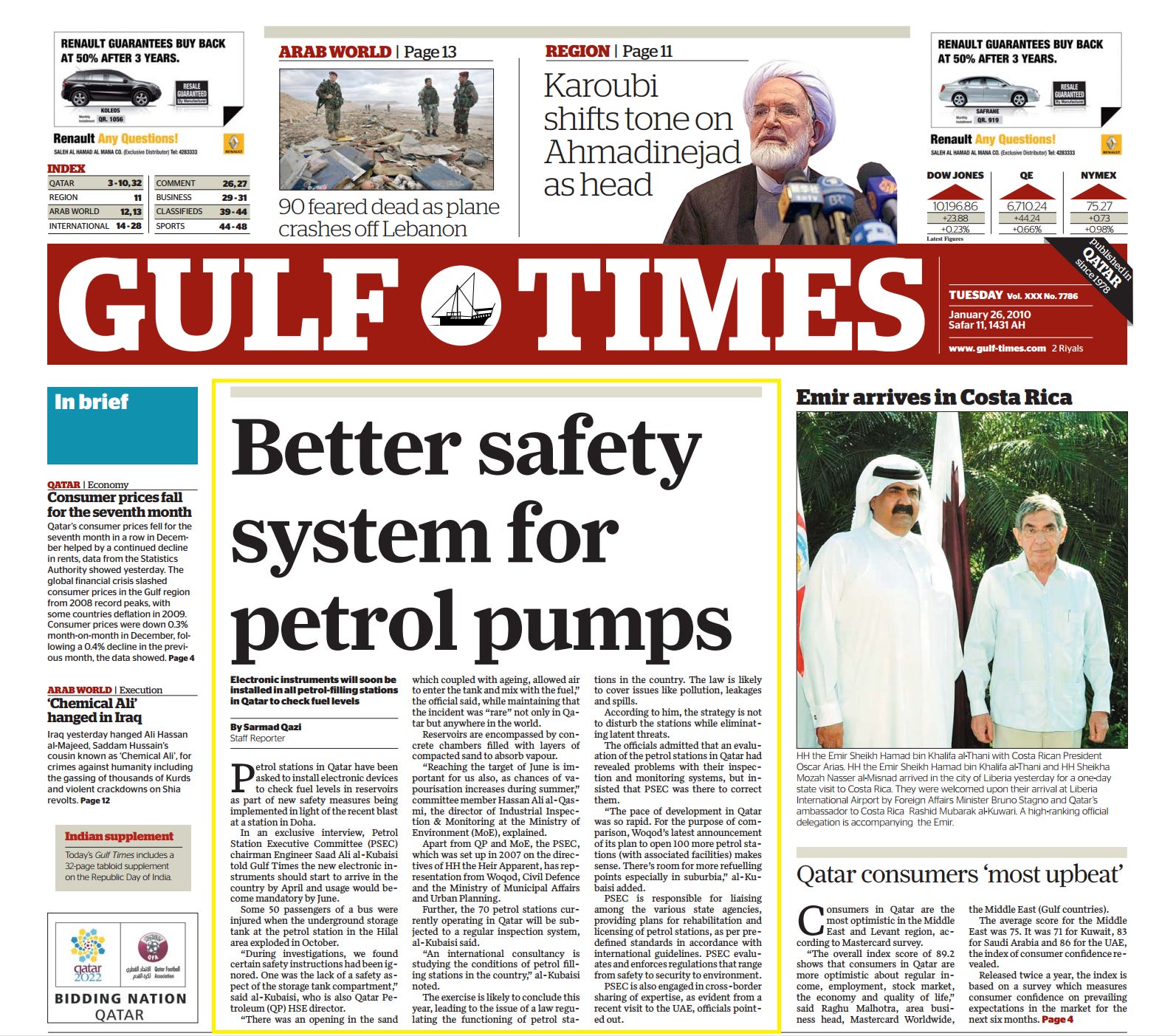
Better safety system for petrol pumps
Originally published in Gulf Times on January 26, 2010
Electronic instruments will soon be installed in all petrol-filling stations in Qatar to check fuel levels
Petrol stations in Qatar have been asked to install electronic devices to check fuel levels in reservoirs as part of new safety measures being implemented in light of the recent blast at a station in Doha.
In an exclusive interview, Petrol Station Executive Committee (PSEC) chairman Engineer Saad Ali al-Kubaisi told Gulf Times the new electronic instruments should start to arrive in the country by April and usage would become mandatory by June.
Some 50 passengers of a bus were injured when the underground storage tank at the petrol station in the Hilal area exploded in October.
“During investigations, we found certain safety instructions had been ignored. One was the lack of a safety aspect of the storage tank compartment,” said al-Kubaisi, who is also Qatar Petroleum (QP) HSE director.
“There was an opening in the sand which coupled with ageing, allowed air to enter the tank and mix with the fuel,” the official said, while maintaining that the incident was “rare” not only in Qatar but anywhere in the world.
Reservoirs are encompassed by concrete chambers filled with layers of compacted sand to absorb vapour. “Reaching the target of June is important for us also, as chances of vapourisation increases during summer,” committee member Hassan Ali al-Qasmi, the director of Industrial Inspection & Monitoring at the Ministry of Environment (MoE), explained.
Apart from QP and MoE, the PSEC, which was set up in 2007 on the directives of HH the Heir Apparent, has representation from Woqod, Civil Defence and the Ministry of Municipal Affairs and Urban Planning. Further, the 70 petrol stations currently operating in Qatar will be subjected to a regular inspection system, al-Kubaisi said.
“An international consultancy is studying the conditions of petrol filling stations in the country,” al-Kubaisi noted.
The exercise is likely to conclude this year, leading to the issue of a law regulating the functioning of petrol stations in the country.
The law is likely to cover issues like pollution, leakages and spills.
According to him, the strategy is not to disturb the stations while eliminating latent threats.
The officials admitted that an evaluation of the petrol stations in Qatar had revealed problems with their inspection and monitoring systems, but insisted that PSEC was there to correct them. “The pace of development in Qatar was so rapid. For the purpose of comparison, Woqod’s latest announcement of its plan to open 100 more petrol stations (with associated facilities) makes sense.
There’s room for more refuelling points especially in suburbia,” al-Kubaisi added. PSEC is responsible for liaising among the various state agencies, providing plans for rehabilitation and licensing of petrol stations, as per pre-defined standards in accordance with international guidelines.
PSEC evaluates and enforces regulations that range from safety to security to environment. PSEC is also engaged in cross-border sharing of expertise, as evident from his recent visit to the UAE, officials pointed out.
As Published