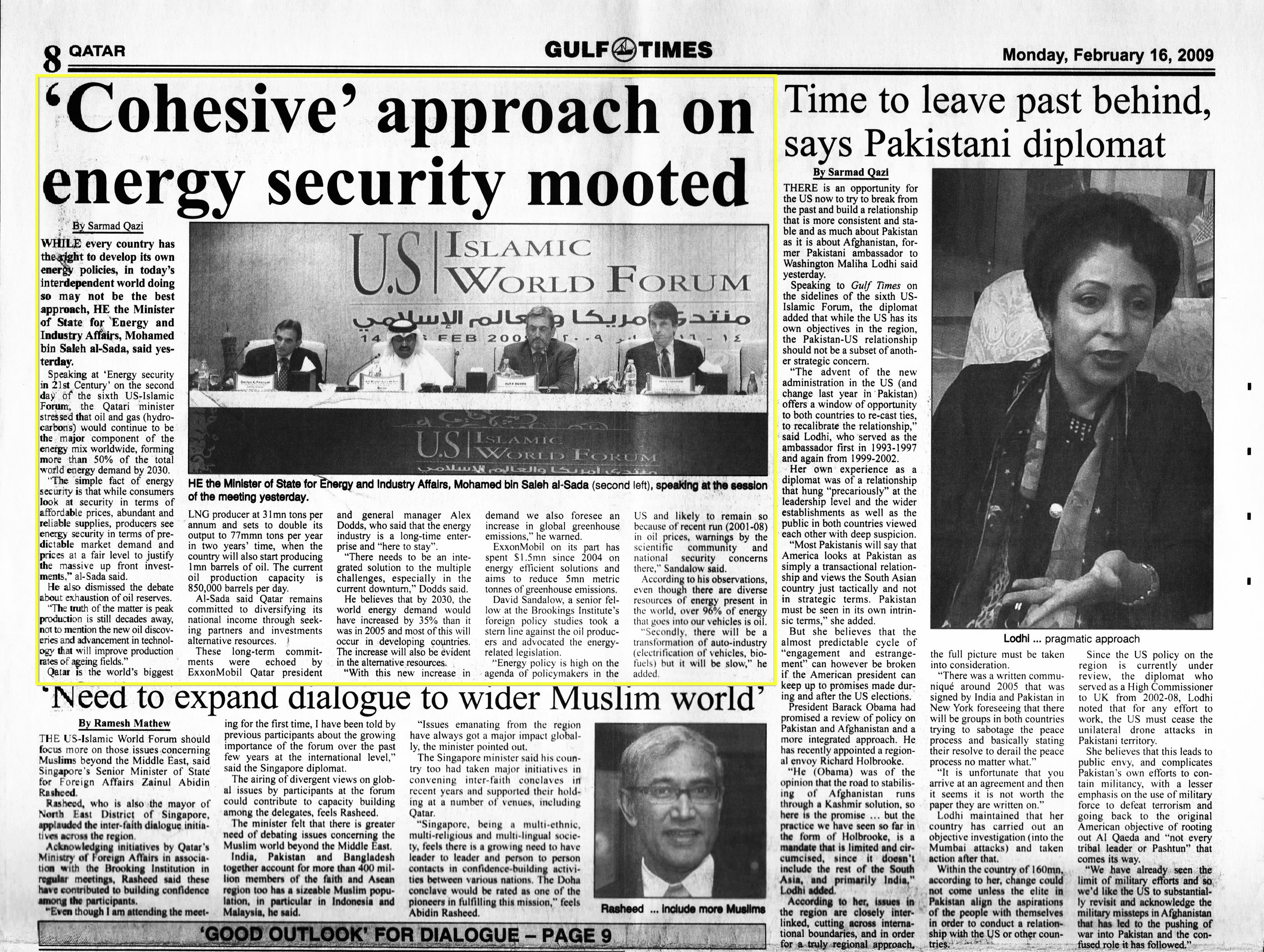
'Cohesive' approach on energy security mooted
Originally published in Gulf Times on February 16, 2009
WHILE every country has the right to develop its own energy policies, in today’s interdependent world doing so may not be the best approach, HE the Minister of State for Energy and Industry Affairs, Mohamed bin Saleh al-Sada, said yesterday.
Speaking at ‘Energy security in 21st Century’ on the second day of the sixth US-Islamic Forum, the Qatari minister stressed that oil and gas (hydrocarbons) would continue to be the major component of the energy mix worldwide, forming more than 50% of the total world energy demand by 2030.
“The simple fact of energy security is that while consumers look at security in terms of affordable prices, abundant and reliable supplies, producers see energy security in terms of predictable market demand and prices at a fair level to justify the massive up front investments,” al-Sada said.
He also dismissed the debate about exhaustion of oil reserves.
“The truth of the matter is peak production is still decades away, not to mention the new oil discoveries and advancement in technology that will improve production rates of ageing fields.”
Qatar is the world’s biggest LNG producer at 31mn tons per annum and sets to double its output to 77mn tons per year in two years’ time, when the country will also start producing 1mn barrels of oil. The current oil production capacity is 850,000 barrels per day.
Al-Sada said Qatar remains committed to diversifying its national income through seeking partners and investments alternative resources.
These long-term commitments were echoed by ExxonMobil Qatar president and general manager Alex Dodds, who said that the energy industry is a long-time enterprise and “here to stay”.
“There needs to be an integrated solution to the multiple challenges, especially in the current downturn,” Dodds said.
He believes that by 2030, the world energy demand would have increased by 35% than it was in 2005 and most of this will occur in developing countries. The increase will also be evident in alternative resources.
“With this new increase in demand we also foresee an increase in global greenhouse emissions,” he warned.
ExxonMobil on its part has spent $1.5mn since 2004 on energy efficient solutions and aims to reduce 5mn metric tonnes of greenhouse emissions.
David Sandalow, a senior fellow at the Brookings Institute’s foreign policy studies took a stern line against the oil producers and advocated the energy-related legislation.
“Energy policy is high on the agenda of policymakers in the US and likely to remain so because of recent run (2001-08) in oil prices, warnings by the scientific community and national security concerns there,” Sandalow said.
According to his observations, even though there are diverse resources of energy present in the world, over 96% of energy that goes into our vehicles is oil.
“Secondly, there will be a transformation of auto-industry (electrification of vehicles, biofuels) but it will be slow,” he added.
As Published