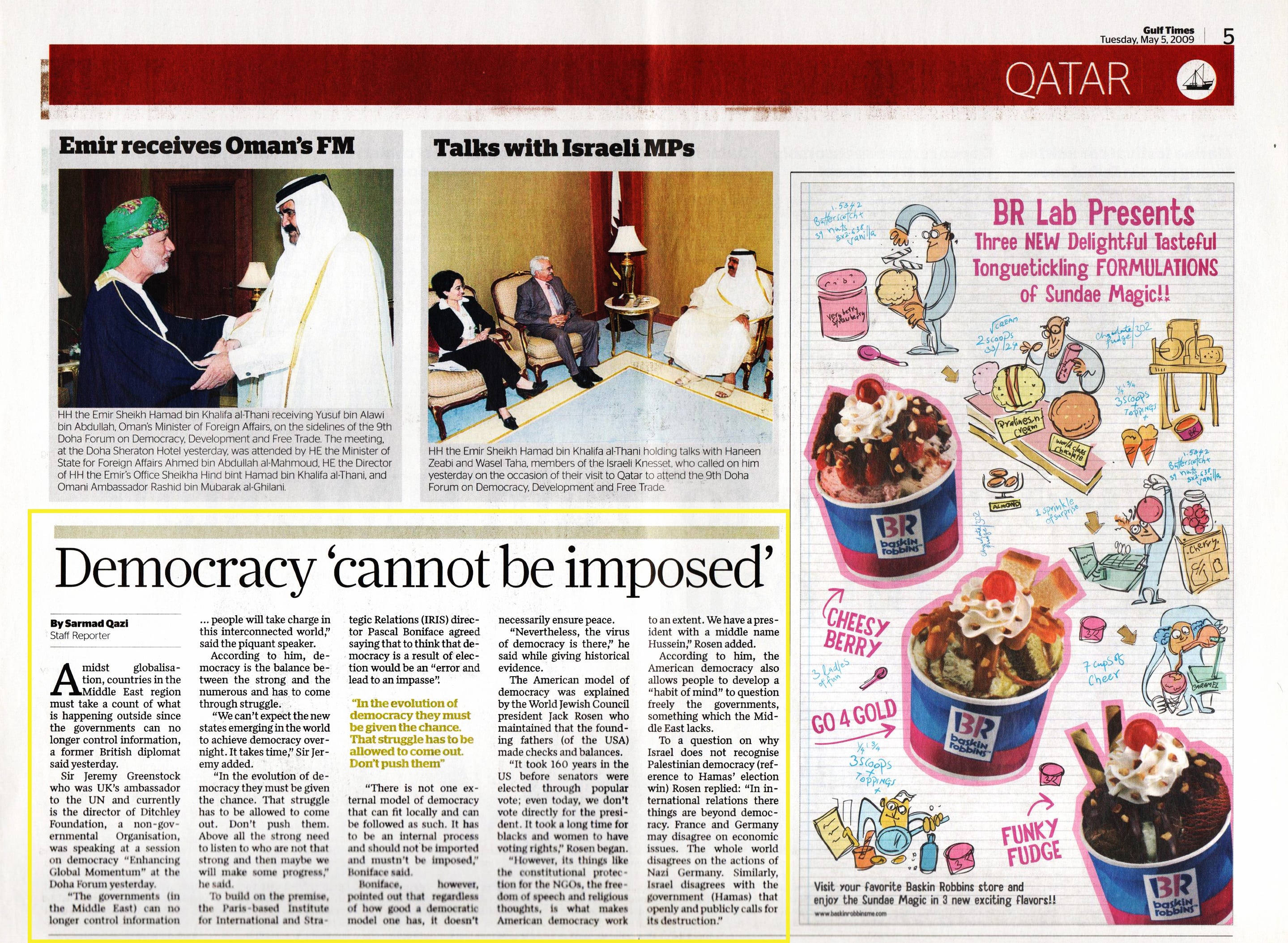
Democracy 'cannot be imposed'
Originally published in Gulf Times on May 5, 2009
Amidst globalisation, countries in the Middle East region must take a count of what is happening outside since the governments can no longer control information, a former British diplomat said yesterday.
Sir Jeremy Greenstock who was UK’s ambassador to the UN and currently is the director of Ditchley Foundation, a non-governmental organisation, was speaking at a session on democracy “Enhancing Global Momentum” at the Doha Forum yesterday.
“The governments (in the Middle East) can no longer control information … people will take charge in this interconnected world,” said the piquant speaker.
According to him, democracy is the balance between the strong and the numerous and has to come through struggle.
“We can’t expect the new states emerging in the world to achieve democracy overnight. It takes time,” Sir Jeremy added.
“In the evolution of democracy they must be given the chance. That struggle has to be allowed to come out. Don’t push them. Above all the strong need to listen to who are not that strong and then maybe we will make some progress,” he said.
To build on the premise, the Paris-based Institute for International and Strategic Relations (IRIS) director Pascal Boniface agreed saying that to think that democracy is a result of election would be an “error and lead to an impasse”.
“There is not one external model of democracy that can fit locally and can be followed as such. It has to be an internal process and should not be imported and mustn’t be imposed,” Boniface said.
Boniface, however, pointed out that regardless of how good a democratic model one has, it doesn’t necessarily ensure peace.
“Nevertheless, the virus of democracy is there,” he said while giving historical evidence.
The American model of democracy was explained by the World Jewish Council president Jack Rosen who maintained that the founding fathers (of the USA) made checks and balances.
“It took 160 years in the US before senators were elected through popular vote; even today, we don’t vote directly for the president. It took a long time for blacks and women to have voting rights,” Rosen began.
“However, its things like the constitutional protection for the NGOs, the freedom of speech and religious thoughts, is what makes American democracy work to an extent. We have a president with a middle name Hussein,” Rosen added.
According to him, the American democracy also allows people to develop a “habit of mind” to question freely the governments, something which the Middle East lacks.
To a question on why Israel does not recognise Palestinian democracy (reference to Hamas’ election win) Rosen replied: “In international relations there things are beyond democracy. France and Germany may disagree on economic issues. The whole world disagrees on the actions of Nazi Germany. Similarly, Israel disagrees with the government (Hamas) that openly and publicly calls for its destruction.”
As Published