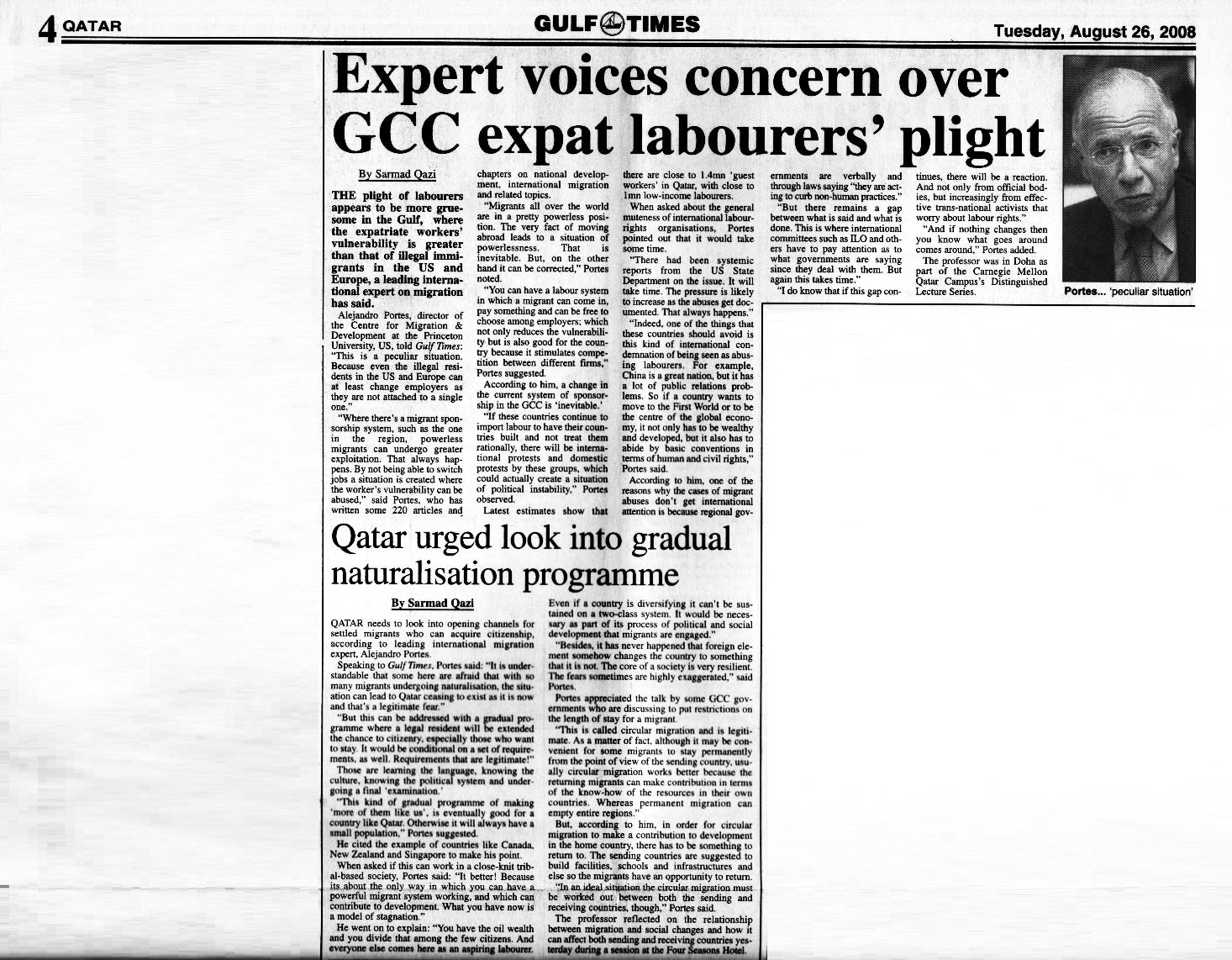
Expert voices concern over GCC expat labourers' plight
Originally published in Gulf Times on August 26, 2008
THE plight of labourers appears to be more gruesome in the Gulf, where the expatriate workers’ vulnerability is greater than that of illegal immigrants in the US and Europe, a leading international expert on migration has said.
Alejandro Portes, director of the Center for Migration & Development at the Princeton University, US, told Gulf Times: “This is a very special situation. Because even the illegal residents in the US and Europe can at least change employers as they are not attached to a single one.”
“Where there’s a migrant sponsorship system, such as the one in the region, powerless workers are subjected to exploitation. That always happens. By not being able to switch jobs a situation is created where workers feel trapped and potentially abused,” said Portes, who has co-authored several books and chapters on national development, international migration and related topics.
“Migrants all over the world are in a pretty powerless position. The very fact of moving across borders creates a sense of powerlessness. That is inevitable. But, on the other hand it can be corrected,” Portes noted.
“You can have a labour system in which a migrant can come in, pay something and can be free to choose among employers, which is not only good for the individual but is also good for the country because it stimulates competition between different firms,” Portes suggested.
According to him, a change in the current system of sponsorship in the GCC is ‘inevitable’.
“If these countries continue to bring in and use foreign workers to build and not treat them rationally, there will be international protests and domestic situations emerge which could actually create a situation of political instability,” Portes observed.
Latest estimates show that there are close to 1.4mn ‘guest workers’ in Qatar, with close to 1mn low-income labourers.
When asked about the general nuances of international labour agreements, Portes opined that it would take some time.
“There had been systemic reports from the US State Department on the issue. It will take time. The pressure is likely to increase as the abuses get documented. That always happens.”
“Indeed, one of the things that these countries should avoid is this kind of international condemnation about the existing labourers. For example, China is a great nation, but it has a lot of public relations problems. So if a country wants to move to the First World or to be the centre of the global economy, it not only has to be wealthy and developed, but it also has to abide by basic conventions in terms of human and civil rights,” Portes said.
According to him, one of the reasons why the cases of migrant abuses don’t get international attention is because regional governments are verbally and through laws saying “they are acting to curb non-human practices.”
“But there remains a gap between what is said and what is done. This is where international community such as ILO and others have to pay attention as to what governments are saying since they deal with them. But again this takes time.”
“I do know that if this gap continues, there will be a reaction. And not only from official bodies, but increasingly from effective trans-national activists that worry about labour rights.”
“And if nothing changes then it shows what goes around comes around,” Portes added.
The professor was speaking as part of the Carnegie Mellon Qatar Campus’s Distinguished Lecture Series.
As Published