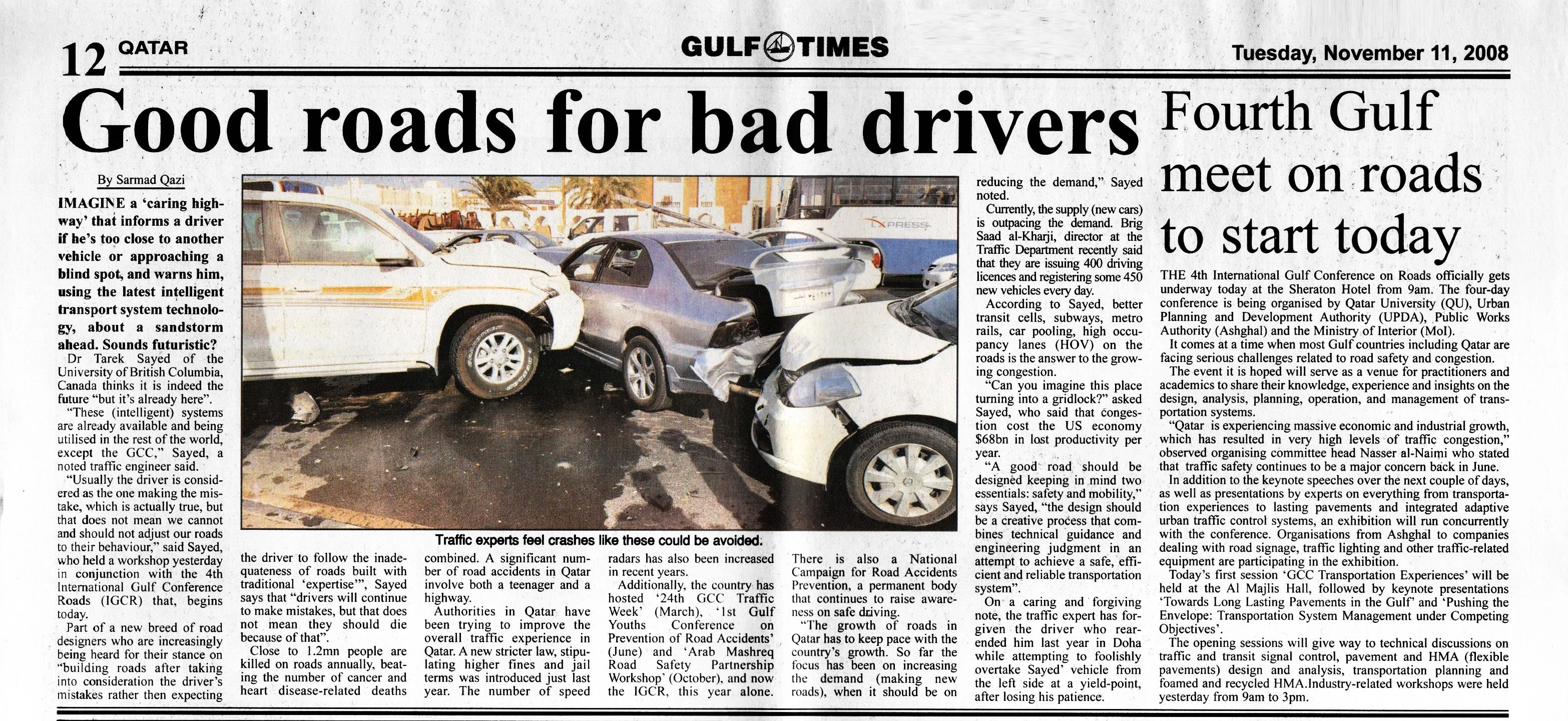
Good roads for bad drivers
Originally published in Gulf Times on November 11, 2008
IMAGINE a ‘caring highway’ that informs a driver if he’s too close to another vehicle or approaching a blind spot, and warns him, using the latest intelligent transport system technology, about a sandstorm ahead. Sounds futuristic?
Dr Tarek Sayed of the University of British Columbia, Canada thinks it is indeed the future “but it’s already here”.
“These (intelligent) systems are already available and being utilised in the rest of the world, except the GCC,” Sayed, a noted traffic engineer said.
“Usually the driver is considered as the one making the mistake, which is actually true, but that does not mean we cannot and should not adjust our roads to their behaviour,” said Sayed, who held a workshop yesterday in conjunction with the 4th International Gulf Conference Roads (IGCR) that, begins today.
Part of a new breed of road designers who are increasingly being heard for their stance on “building roads after taking into consideration the driver’s mistakes rather then expecting the driver to follow the inadequateness of roads built with traditional ‘expertise’”, Sayed says that “drivers will continue to make mistakes, but that does not mean they should die because of that”.
Close to 1.2mn people are killed on roads annually, beating the number of cancer and heart disease-related deaths combined. A significant number of road accidents in Qatar involve both a teenager and a highway.
Authorities in Qatar have been trying to improve the overall traffic experience in Qatar. A new stricter law, stipulating higher fines and jail terms was introduced just last year. The number of speed radars has also been increased in recent years.
Additionally, the country has hosted ‘24th GCC Traffic Week’ (March), ‘1st Gulf Youths Conference on Prevention of Road Accidents’ (June) and ‘Arab Mashreq Road Safety Partnership Workshop’ (October), and now the IGCR, this year alone.
There is also a National Campaign for Road Accidents Prevention, a permanent body that continues to raise awareness on safe driving.
“The growth of roads in Qatar has to keep pace with the country’s growth. So far the focus has been on increasing the demand (making new roads), when it should be on reducing the demand,” Sayed noted.
Currently, the supply (new cars) is outpacing the demand. Brig Saad al-Kharji, director at the Traffic Department recently said that they are issuing 400 driving licences and registering some 450 new vehicles every day.
According to Sayed, better transit cells, subways, metro rails, car pooling, high occupancy lanes (HOV) on the roads is the answer to the growing congestion.
“Can you imagine this place turning into a gridlock?” asked Sayed, who said that congestion cost the US economy $68bn in lost productivity per year.
“A good road should be designed keeping in mind two essentials: safety and mobility,” says Sayed, “the design should be a creative process that combines technical guidance and engineering judgment in an attempt to achieve a safe, efficient and reliable transportation system”.
On a caring and forgiving note, the traffic expert has forgiven the driver who rearended him last year in Doha while attempting to foolishly overtake Sayed’ vehicle from the left side at a yield-point, after losing his patience.
As Published