Mayassa: we need to find our own cultural identity
Originally published in Gulf Times on December 10, 2010
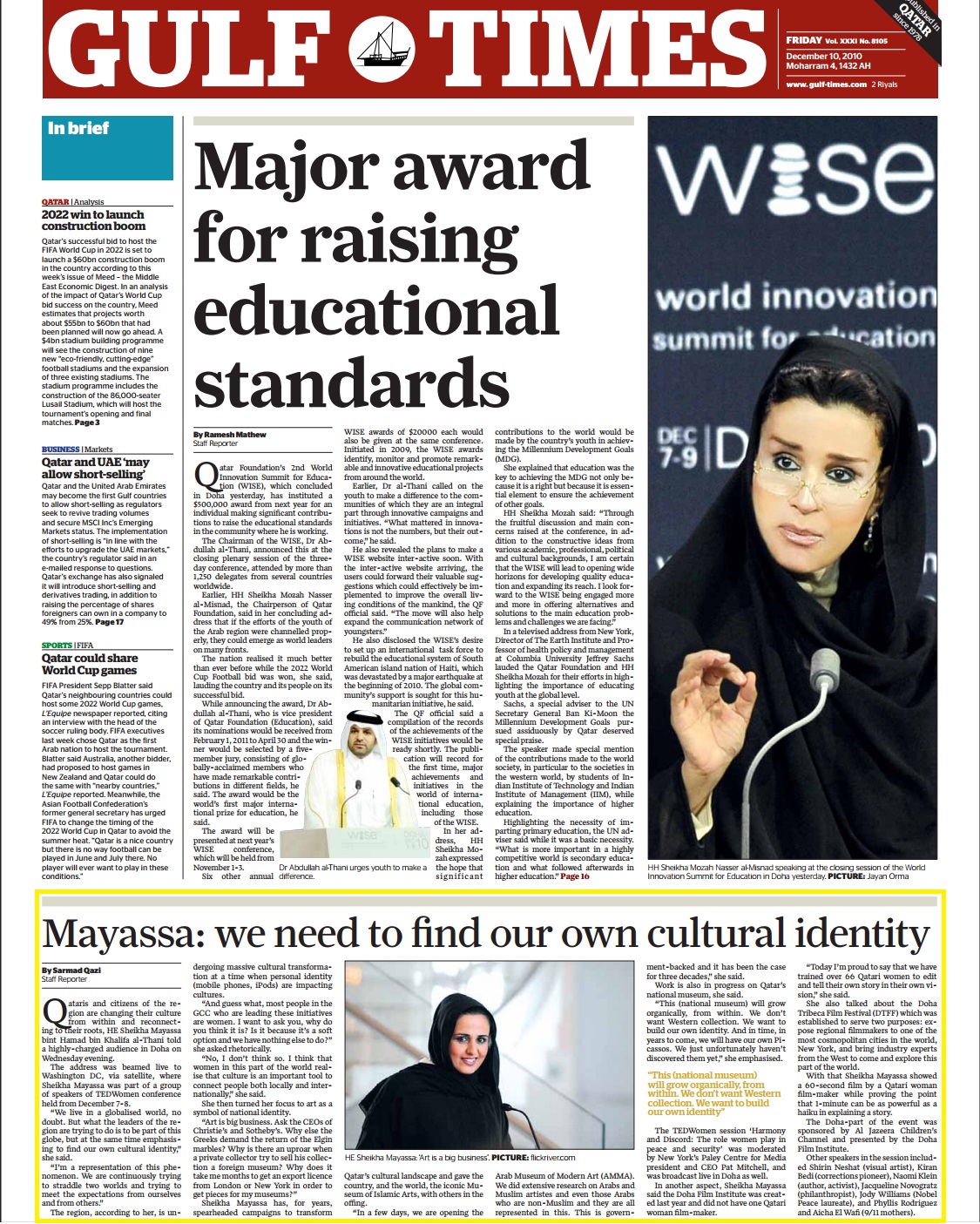
Qataris and citizens of the region are changing their culture from within and reconnecting to their roots, HE Sheikha Mayassa bint Hamad bin Khalifa al-Thani told a highly-charged audience in Doha on Wednesday evening.
The address was beamed live to Washington DC, via satellite, where Sheikha Mayassa was part of a group of speakers of TEDWomen conference held from December 7-8. “We live in a globalised world, no doubt. But what the leaders of the region are trying to do is to be part of this globe, but at the same time emphasising to find our own cultural identity,” she said.
“I’m a representation of this phenomenon. We are continuously trying to straddle two worlds and trying to meet the expectations from ourselves and from others.”
The region, according to her, is undergoing massive cultural transformation at a time when personal identity (mobile phones, iPods) are impacting cultures.
“And guess what, most people in the GCC who are leading these initiatives are women. I want to ask you, why do you think it is? Is it because it’s a soft option and we have nothing else to do?” she asked rhetorically.
“No, I don’t think so. I think that women in this part of the world realise that culture is an important tool to connect people both locally and internationally,” she said.
She then turned her focus to art as a symbol of national identity.
“Art is big business. Ask the CEOs of Christie’s and Sotheby’s. Why else the Greeks demand the return of the Elgin marbles? Why is there an uproar when a private collector try to sell his collection a foreign museum? Why does it take me months to get an export licence from London or New York in order to get pieces for my museums?” Sheikha Mayassa has, for years, spearheaded campaigns to transform Qatar’s cultural landscape and gave the country, and the world, the iconic Museum of Islamic Arts, with others in the offing.
“In a few days, we are opening the Arab Museum of Modern Art (AMMA). We did extensive research on Arabs and Muslim artistes and even those Arabs who are non-Muslim and they are all represented in this. This is government-backed and it has been the case for three decades,” she said.
Work is also in progress on Qatar’s national museum, she said.
“This (national museum) will grow organically, from within. We don’t want Western collection. We want to build our own identity. And in time, in years to come, we will have our own Picassos.
We just unfortunately haven’t discovered them yet,” she emphasised.
The TEDWomen session ‘Harmony and Discord: The role women play in peace and security’ was moderated by New York’s Paley Centre for Media president and CEO Pat Mitchell, and was broadcast live in Doha as well. In another aspect, Sheikha Mayassa said the Doha Film Institute was created last year and did not have one Qatari woman film-maker.
“Today I’m proud to say that we have trained over 66 Qatari women to edit and tell their own story in their own vision,” she said.
She also talked about the Doha Tribeca Film Festival (DTFF) which was established to serve two purposes: expose regional filmmakers to one of the most cosmopolitan cities in the world, New York, and bring industry experts from the West to come and explore this part of the world.
With that Sheikha Mayassa showed a 60-second film by a Qatari woman film-maker while proving the point that 1-minute can be as powerful as a haiku in explaining a story.
The Doha-part of the event was sponsored by Al Jazeera Children’s Channel and presented by the Doha Film Institute. Other speakers in the session included Shirin Neshat (visual artist), Kiran Bedi (corrections pioneer), Naomi Klein (author, activist), Jacqueline Novogratz (philanthropist), Jody Williams (Nobel Peace laureate), and Phyllis Rodriguez and Aicha El Wafi (9/11 mothers).
As Published