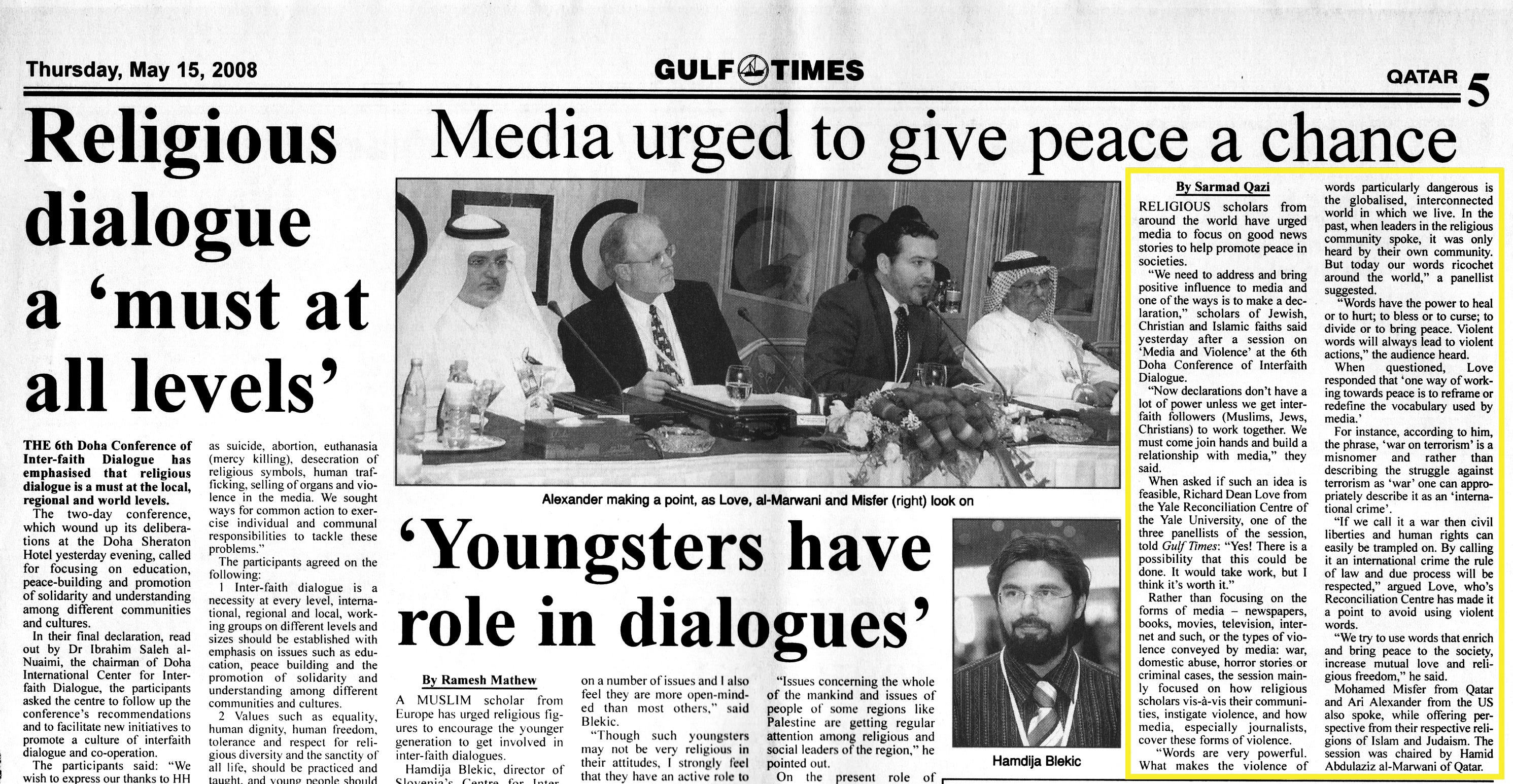
Media urged to give peace a chance
Originally published in Gulf Times on May 15, 2008
RELIGIOUS scholars from around the world have urged media to focus on good news stories to help promote peace in society.
“We need to address and bring positive influence to media and use of language in a manner befitting religion,” scholars of Jewish, Christian and Islamic faiths said yesterday at the session on “Media and Violence” at the 6th Doha Conference of Interfaith Dialogue.
“Nice declarations don’t have a lot of power unless we get interaction between scholars and Christians with media together. We must come join hands and build a relationship with media,” they said.
When asked if such an idea is realistic, Richard Dunn Love from the Yale Reconciliation Centre of the USA and one of the key panelists of the session, told Gulf Times: “Well there is a big difference between what can be done. It would take work, but I think it’s worth it.”
“Media’s role in focusing on the forms of media - newspapers, books, movies, television, internet - and how we use them to convey peace or violence conveyed by media: war, violence versus love and reconciliation,” Love added. The session primarily focused on how religious scholars view and use their community’s media, especially journalism, to cover their forms of religious expression.
“Words are very powerful. What media do, ‘violence’ is words particularly dangerous to the globalized, interconnected world in which we live. In the past when media in an isolated community spoke, it was only heard by their own community, but today our words ricochet around the world,” a panelist suggested.
“Words have the power to hurt or heal, to scare or to cure, to divide or to bring peace. Violent words will always fetch violent actions,” the audience heard.
When questioned, Love responded that “one way of working towards peace is to reframe or redefine the vocabulary that we use.”
For instance, according to him, the phrase “war on terrorism” is a misnomer and rather than describing the struggle against terrorism as a “war,” one should rightly describe it as an “international crime”.
“It’s not a war that civil liberties and human rights can easily be trampled on. By calling it an international crime, the rule of law and due process will be protected,” argued Love, who’s also a professor. He also stressed a point to avoid using violent words.
“We have to use words that enrich and bring peace to the society, increase mutual love and religious harmony,” he added.
Mohamed Misfer from Qatar and Ari Alexander from the US also spoke, while offering perspective from their respective religious views on Islam and Judaism. The session was chaired by Hamid Abdulaziz al-Marwani of Qatar.
As Published