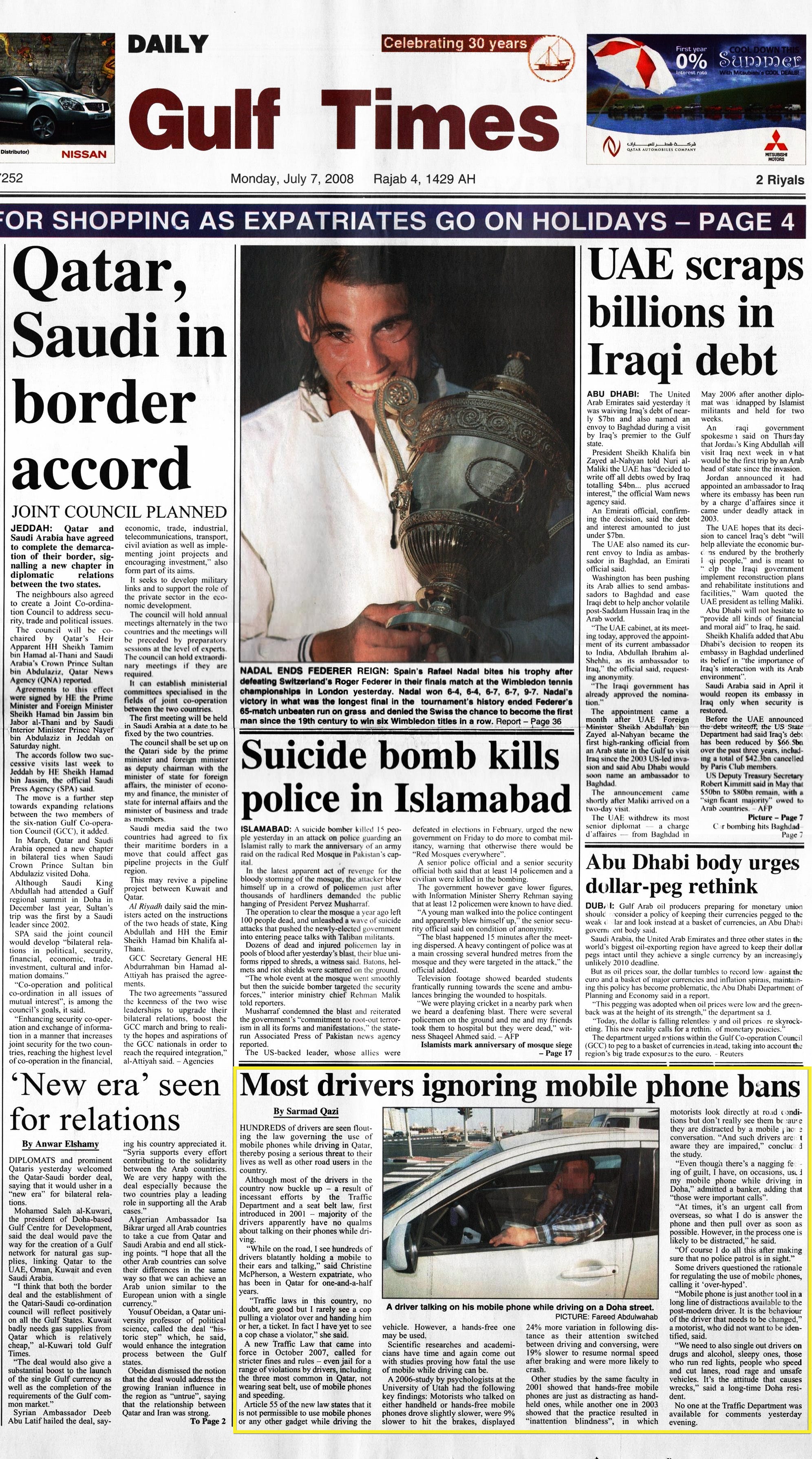
Most drivers ignoring mobile phone bans
Originally published in Gulf Times on July 7, 2008
HUNDREDS of drivers are seen flouting the law governing the use of mobile phones while driving in Qatar, thereby posing a serious threat to their lives as well as other road users in the country.
Although most of the drivers in the country now buckle up – a result of incessant efforts by the Traffic Department and a seat belt law, first introduced in 2001 – majority of the drivers apparently have no qualms about talking on their phones while driving.
“While on the road, I see hundreds of drivers blatantly holding a mobile to their ears and talking,” said Christine McPherson, a Western expatriate, who has been in Qatar for one-and-a-half years.
“Traffic laws in this country, no doubt, are good but I rarely see a cop pulling a violator over and handing him or her, a ticket. In fact I have yet to see a cop chase a violator,” she said.
A new Traffic Law that came into force in October 2007, called for stricter fines and rules – even jail for a range of violations by drivers, including the three most common in Qatar, not wearing seat belt, use of mobile phones and speeding.
Article 55 of the new law states that it is not permissible to use mobile phones or any other gadget while driving the vehicle. However, a hands-free one may be used.
Scientific researches and academicians have time and again come out with studies proving how fatal the use of mobile while driving can be.
A 2006-study by psychologists at the University of Utah had the following key findings: Motorists who talked on either handheld or hands-free mobile phones drove slightly slower, were 9% slower to hit the brakes, displayed 24% more variation in following distance as their attention switched between driving and conversing, were 19% slower to resume normal speed after braking and were more likely to crash.
Other studies by the same faculty in 2001 showed that hands-free mobile phones are just as distracting as handheld ones, while another one in 2003 showed that the practice resulted in “inattention blindness”, in which motorists look directly at road conditions but don’t really see them because they are distracted by a mobile phone conversation. “And such drivers aren’t aware they are impaired,” concluded the study.
“Even though there’s a nagging feeling of guilt, I have, on occasions, used my mobile phone while driving in Doha,” admitted a banker, adding that “those were important calls”.
“At times, it’s an urgent call from overseas, so what I do is answer the phone and then pull over as soon as possible. However, in the process one is likely to be distracted,” he said.
“Of course I do all this after making sure that no police patrol is in sight.”
Some drivers questioned the rationale for regulating the use of mobile phones, calling it ‘over-hyped’.
“Mobile phone is just another tool in a long line of distractions available to the post-modern driver. It is the behaviour of the driver that needs to be changed,” a motorist, who did not want to be identified, said.
“We need to also single out drivers on drugs and alcohol, sleepy ones, those who run red lights, people who speed and cut lanes, road rage and unsafe vehicles. It’s the attitude that causes wrecks,” said a long-time Doha resident.
No one at the Traffic Department was available for comments yesterday evening.
As Published