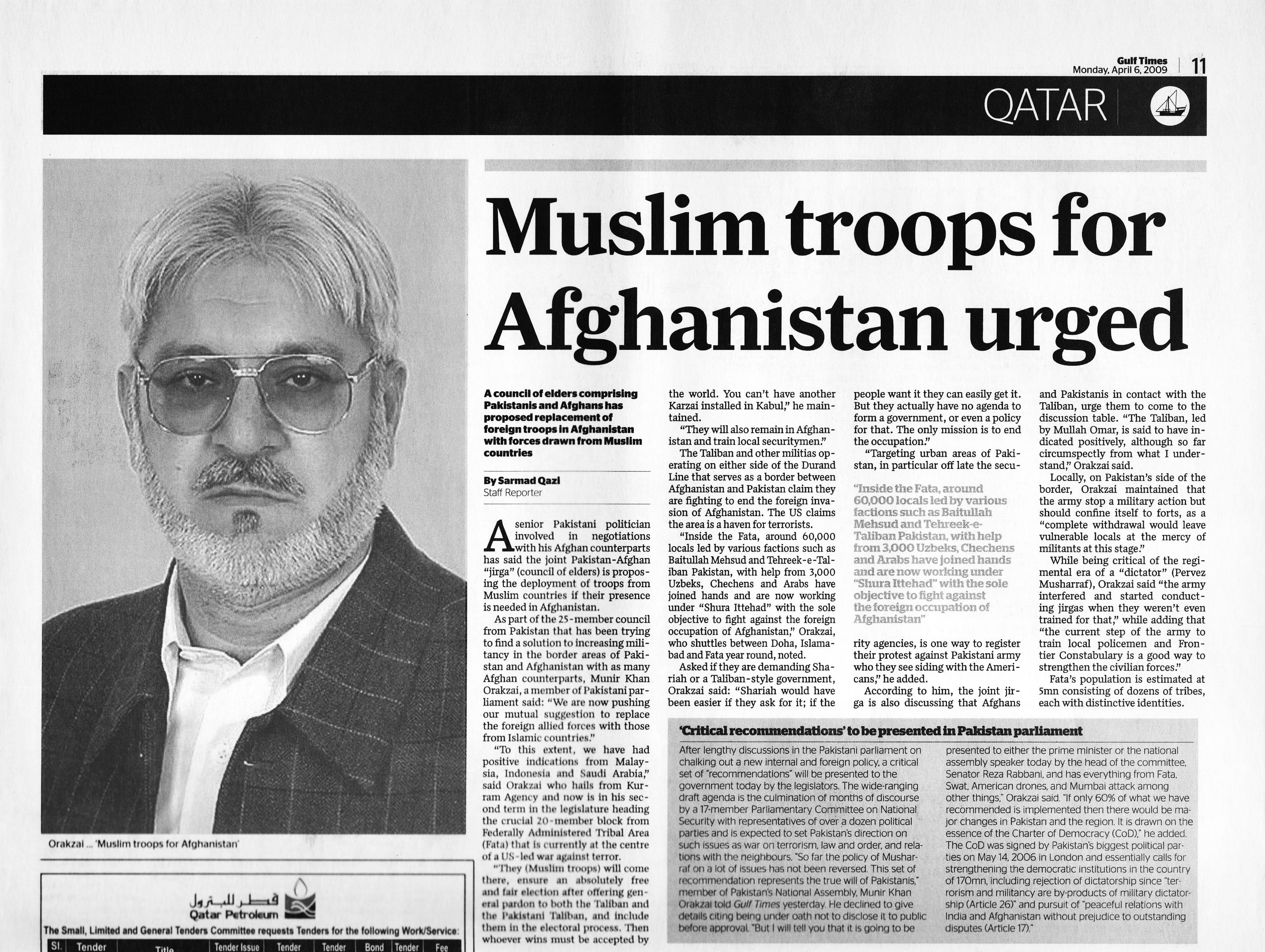
Muslim troops for Afghanistan urged
Originally published in Gulf Times on April 6, 2009
A senior Pakistani politician involved in negotiations with his Afghan counterparts has said the joint Pakistani-Afghan “jirga” (council of elders) is proposing the deployment of troops from Muslim countries if their presence is needed in Afghanistan.
As part of the 25-member council from Pakistan that has been trying to find a solution to increasing militancy in the border areas of Pakistan and Afghanistan with as many Afghan counterparts, Munir Khan Orakzai, a member of Parliament said: “We are now pushing our mutual suggestion to replace the foreign allied forces with those from Islamic countries.”
“To this extent, we have had positive indications from Malaysia, Indonesia and Saudi Arabia,” said Orakzai who hails from Kurram Agency and now is in his second term in the legislature heading the crucial 40-member block from Federally Administrated Tribal Area (Fata) that is currently at the centre of a US-led war against terror.
“They (Muslim troops) will come there, ensure an absolutely free and fair election after offering general pardon to both the Taliban and the Pakistani Taliban, and include them in the electoral process. Then whoever wins must be accepted by the world. You can’t have another Karzai installed in Kabul,” he maintained.
“They will also remain in Afghanistan and train local securitymen.”
The Taliban and other militias operating on either side of the Durand Line that serves as a border between Afghanistan and Pakistan claim they are fighting to end the foreign invasion of Afghanistan. The US claims the area is a haven for terrorists.
“Inside the Fata, around 60,000 locals led by various factions such as Baitullah Mehsud and Tehreek-e-Taliban Pakistan, with help from 3,000 Uzbeks, Chechens and Arabs have joined hands and are now working under “Shura Ittehad” with the sole objective to fight against the foreign occupation of Afghanistan,” Orakzai, who shuttles between Doha, Islamabad and Fata year round, noted.
“Inside the Fata, around 60,000 locals led by various factions such as Baitullah Mehsud and Tehreek-e-Taliban Pakistan, with help from 3,000 Uzbeks, Chechens and Arabs have joined hands and are now working under “Shura Ittehad” with the sole objective to fight against the foreign occupation of Afghanistan”
Asked if they are demanding Shariah or a Taliban-style government, Orakzai said: “Shariah would have been easier if they ask for it; if the people want it they can easily get it. But they actually have no agenda to form a government, or even a policy for that. The only mission is to end the occupation.”
“Targeting urban areas of Pakistan, in particular of late the security agencies, is one way to register their protest against Pakistan army who they see siding with the Americans,” he added.
According to him, the joint jirga is also discussing that Afghans and Pakistanis in contact with the Taliban, urge them to come to the discussion table. “The Taliban, led by Mullah Omar, is said to have indicated positively, although so far circumspectly from what I understand,” Orakzai said.
Locally, on Pakistan’s side of the border, Orakzai maintained that the army stop a military action but should confine itself to forts, as a “complete withdrawal would leave vulnerable locals at the mercy of militants at this stage.”
While being critical of the regimental era of a “dictator” (Pervez Musharraf), Orakzai said “the army interfered and started conducting jirgas when they weren’t even trained for that,” while adding that “the current step of the army to train local policemen and Frontier Constabulary is a good way to strengthen the civilian forces.”
Fata’s population is estimated at 5mn consisting of dozens of tribes, each with distinctive identities.
[Sidebar] ‘Critical recommendations’ to be presented in Pakistan parliament
After lengthy discussions in the Pakistani parliament on chalking out a new internal and foreign policy, a critical set of “recommendations” will be presented to the government today by the legislators. The wide-ranging draft agenda is the culmination of months of discourse by a 17-member Parliamentary Committee on National Security with representatives of over a dozen political parties and is expected to set Pakistan’s direction on such issues as war on terrorism, law and order, and relations with the neighbours. “So far the policy of Musharraf on a lot of issues has not been reversed. This set of recommendation represents the true will of Pakistanis,” member of Pakistan’s National Assembly, Munir Khan Orakzai told Gulf Times yesterday. He declined to give details citing being under oath not to disclose it to public before approval. “But I will tell you that it is going to be presented to either the prime minister or the national assembly speaker today by the head of the committee, Senator Reza Rabbani, and has everything from Fata, Swat, American drones, and Mumbai attack among other things,” Orakzai said. “If only 60% of what we have recommended is implemented then there would be major changes in Pakistan and the region. It is drawn on the essence of the Charter of Democracy (CoD),” he added. The CoD was signed by Pakistan’s biggest political parties on May 14, 2006 in London and essentially calls for strengthening the democratic institutions in the country of 170mn, including rejection of dictatorship since “terrorism and militancy are by-products of military dictatorship (Article 26)” and pursuit of “peaceful relations with India and Afghanistan without prejudice to outstanding disputes (Article 17).”
As Published