Obama 'too weak to make peace'
Originally published in Gulf Times on April 27, 2010
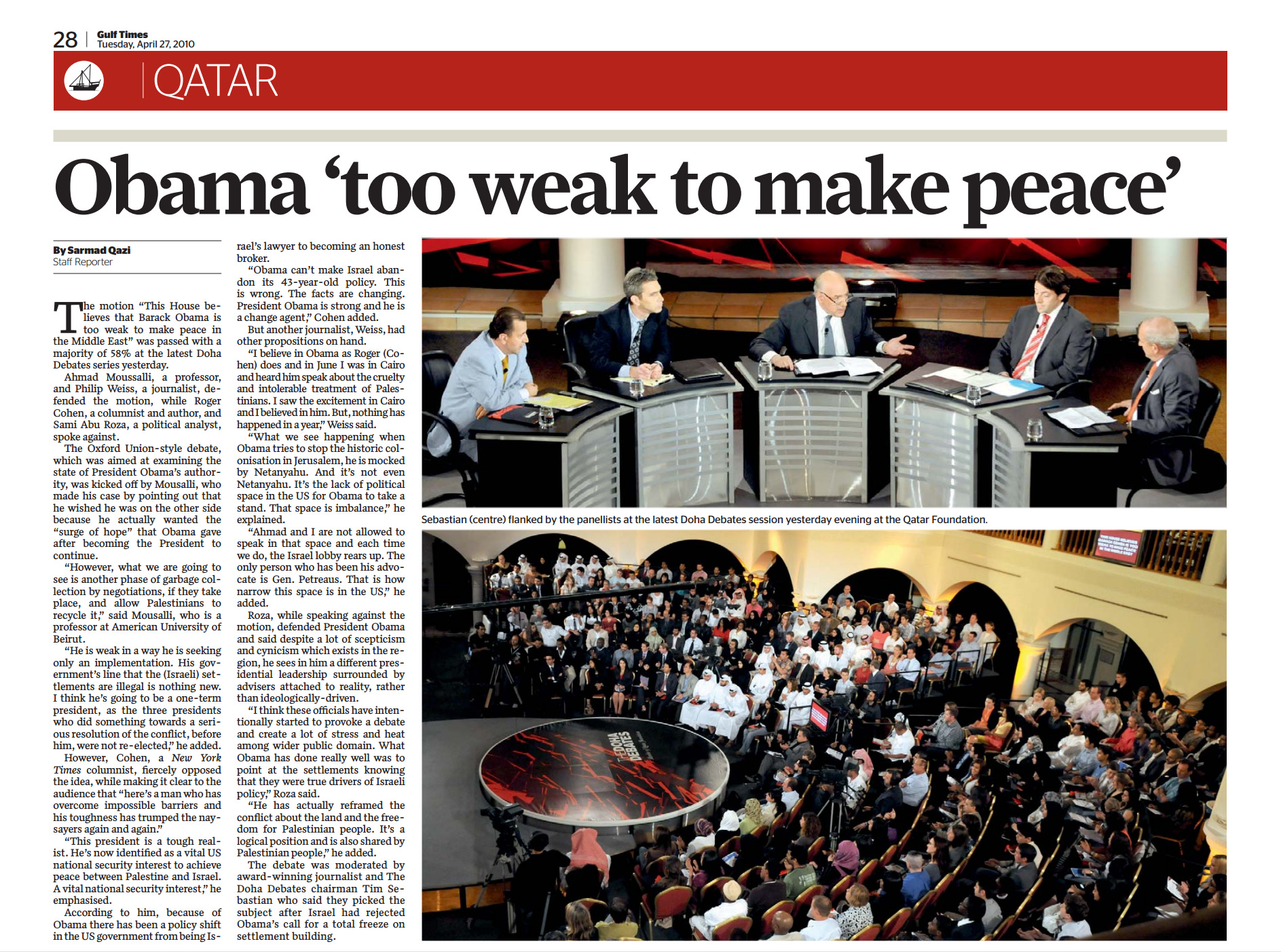
The motion “This House believes that Barack Obama is too weak to make peace in the Middle East” was passed with a majority of 58% at the latest Doha Debates session yesterday.
Ahmad Moussalli, a professor, and Philip Weiss, a journalist, defended the motion, while Roger Cohen, a columnist and author, and Sami Abu Roza, a political analyst, spoke against.
The Oxford Union-style debate, which was aimed at examining the state of President Obama’s authority, was kicked off by Moussalli, who made his case by pointing out that he wished he was on the other side because he actually wanted the “surge of hope” that Obama gave after becoming the President to continue.
“However, what we are going to see is another phase of garbage collection by negotiations, if they take place, and allow Palestinians to receive it,” said Moussalli, who is a professor at American University of Beirut.
“He is weak in a way he is seeking only an implementation. His government’s line that the (Israeli) settlements are illegal is nothing new. I think he is going to be a one-term president, as the three presidents who did something towards a serious resolution of the conflict, before him, were not re-elected,” he added.
However, Cohen, a New York Times columnist, fiercely opposed the idea while standing in front of the audience that “here’s a man who has overcome impossible barriers and his toughness has trumped the naysayers again and again.”
“This president is a tough real-ist. He’s now identified as a vital US national security interest to achieve peace between Palestine and Israel. A vital national security interest,” he emphasised.
According to him, because of Obama there has been a policy shift in the US government from being Israel’s lawyer to becoming an honest broker.
“Obama can’t make Israel abandon its 43-year-old policy. This is wrong. The facts are changing. President Obama’s greatest role is a change agent,” Cohen added.
But another journalist, Weiss, had other propositions on hand.
“I believe in Obama as Roger (Cohen) does and in June I was in Cairo and heard his peak about brutality and intolerable treatment of Palestinians. I saw the excitement in Cairo and I believed in him. But, nothing has happened in a year,” Weiss said.
“What we are happening when Obama files to drop the bilateral negotiations in Jerusalem, he is mocked by Netanyahu. And it’s not even Netanyahu. It’s the lack of political space in the US for Obama to take a stand. That space is imbalance,” he explained.
“Almost and I am not allowed to speak in that space and each time we do, the Israel lobby tears up. The only person who has been his advocate is Gen. Petraeus. That is how narrow this space is in the US,” he added.
Roza, while speaking against the motion, defended President Obama and said despite a lot of scepticism and cynicism which exists in the region, he sees in him a different presidential leadership surrounded by advisers attached to reality, rather than ideologically-driven.
“I think these officials have intentionally started to provoke a debate and create a lot of stress and heat among wider public domain. What Obama has done really well was to point at the settlements knowing that they were the drivers of Israeli policy,” Roza said.
“He has actually reframed the conflict about the land and the freedom for Palestinian people. It’s a logical position and is also shared by Palestinian people,” he added.
The debate was moderated by award-winning journalist and The Doha Debates chairman Tim Sebastian who said they picked the subject after Israel had rejected Obama’s call for a total freeze on settlement building.
As Published