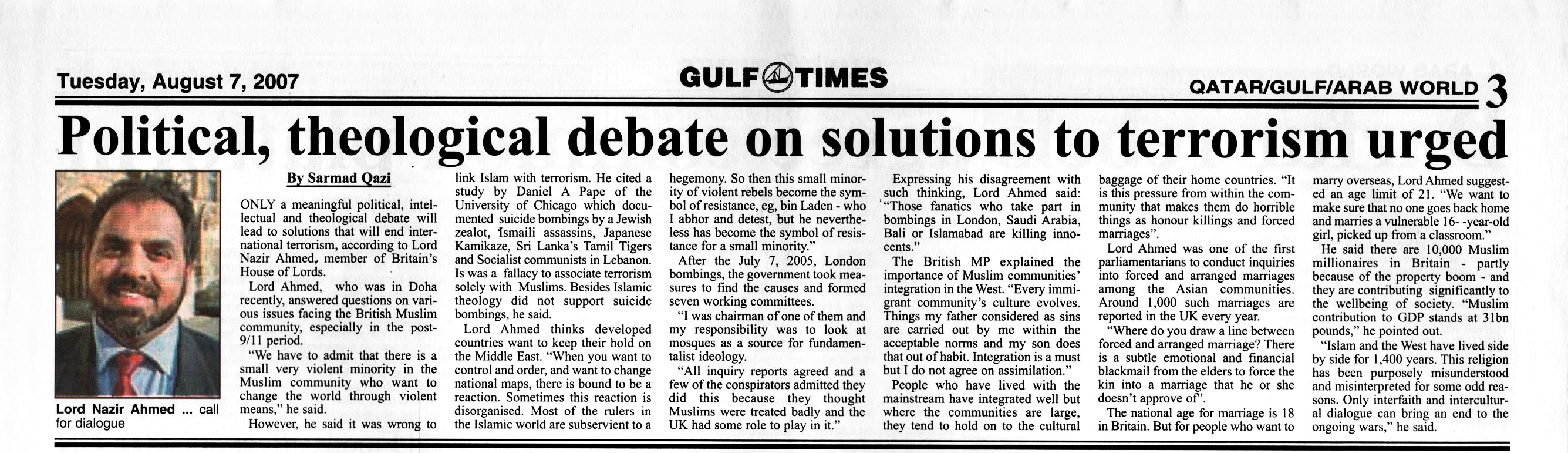
Political, theological debate on solutions to terrorism urged
Originally published in Gulf Times on August 7, 2007
ONLY a meaningful political, intellectual and theological debate will lead to solutions that will end international terrorism, according to Lord Nazir Ahmed, member of Britain’s House of Lords.
Lord Ahmed, who was in Doha recently, answered questions on various issues facing the British Muslim community, especially in the post-9/11 period.
“We have to admit that there is a small very violent minority in the Muslim community who want to change the world through violent means,” he said.
However, he said it was wrong to link Islam with terrorism. He cited a study by Daniel A Pape of the University of Chicago which documented suicide bombings by a Jewish zealot, Ismaili assassins, Japanese Kamikaze, Sri Lanka’s Tamil Tigers and Socialist Communists in Lebanon. It was a fallacy to associate terrorism solely with Muslims. Besides Islamic theology did not support suicide bombings, he said.
Lord Ahmed thinks developed countries want to keep their hold on the Middle East. “When you want to control and order, and want to change national maps, there is bound to be a reaction. Sometimes this reaction is disorganised. Most of the rulers in the Islamic world are subservient to hegemony. So then this small minority of violent rebels become the symbol of resistance, e.g. bin Laden - who I abhor and detest, but he nevertheless had become the symbol of resistance for a small minority.”
After the July 7, 2005 London bombings, the government took measures to find the causes and formed seven working committees.
“I was the chairman of one of them and my responsibility was to look at mosques as a source for fundamentalist ideology.
“All inquiry reports agreed and a few of the conspirators admitted they did this because they thought Muslims were treated badly and the UK has some role to play in it.”
Expressing his disagreement with such thinking, Lord Ahmed said: “Those fanatics who take part in bombings in London, Saudi Arabia, Bali or Islamabad are killing innocents.”
The British MP explained the importance of Muslim communities’ integration in the West. “Every immigrant community’s culture evolves. Things my father considered as sins are carried out by me within the acceptable norms and my son does that out of habit. Integration is a must but I do not agree on assimilation.”
People who have lived with the mainstream have integrated well but where the communities are large, they tend to hold on to the cultural baggage of their home countries. “It is this pressure from within the community that makes them do horrible things as honour killings and forced marriages.”
Lord Ahmed was one of the first parliamentarians to conduct inquiries into forced and arranged marriages among Asian communities. Around 1,000 such marriages are reported in the UK every year.
“Where do you draw the line between forced and arranged marriage? There is a subtle emotional and financial blackmail from the elders to force the kin into a marriage that he or she doesn’t approve of.”
The national age for marriage is 18 in Britain. But for people who want to marry overseas, Lord Ahmed suggested an age limit of 21. “We want to make sure that no one goes back home and marries a vulnerable 16-year-old girl picked from a classroom.”
He said there are 10,000 Muslim millionaires in Britain, partly because of the property boom, and they are contributing significantly to the wellbeing of the society. “Muslim contribution to GDP stands at 31bn pounds,” he pointed out.
“Islam and the West have lived side by side for 1,400 years. The religion has been purposely misunderstood and misinterpreted for some odd reasons. Only interfaith and intercultural dialogue can bring an end to the ongoing wars,” he said.
As Published