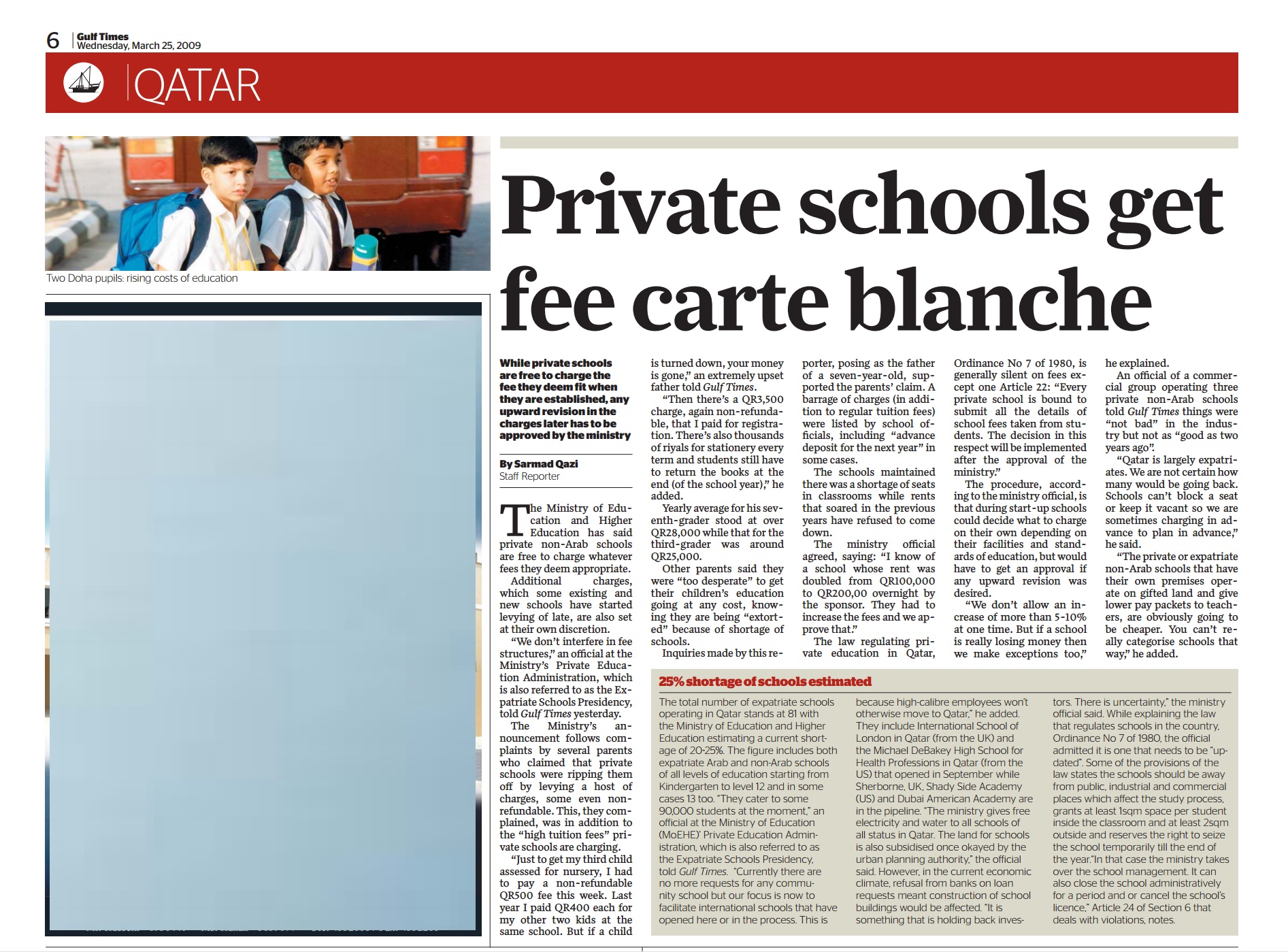
Private schools get fee carte blanche
Originally published in Gulf Times on March 25, 2009
While private schools are free to charge the fee they deem fit when they are established, any upward revision in the charges later has to be approved by the ministry.
The Ministry of Education and Higher Education has said private non-Arab schools are free to charge whatever fees they deem appropriate.
Additional charges, which some existing and new schools have started levying of late, are also set at their own discretion. “We don’t interfere in fee structures,” an official at the Ministry’s Private Education Administration, which is also referred to as the Expatriate Schools Presidency, told Gulf Times yesterday.
The Ministry’s announcement follows complaints by several parents who claimed that private schools were ripping them off by levying a host of charges, some even non-refundable.
This, they complained, was in addition to the “high tuition fees” private schools are charging. “Just to get my third child assessed for nursery, I had to pay a non-refundable QR500 fee this week. Last year I paid QR400 each for my other two kids at the same school. But if a child is turned down, your money is gone,” an extremely upset father told Gulf Times.
“Then there’s a QR3,500 charge, again non-refundable, that I paid for registration. There’s also thousands of riyals for stationery every term and students still have to return the books at the end (of the school year),” he added.
Yearly average for his seventh-grader stood at over QR28,000 while that for the third-grader was around QR25,000. Other parents said they were “too desperate” to get their children’s education going at any cost, knowing they are being “extorted” because of shortage of schools.
Inquiries made by this reporter, posing as the father of a seven-year-old, supported the parents’ claim. A barrage of charges (in addition to regular tuition fees) were listed by school officials, including “advance deposit for the next year” in some cases.
The schools maintained there was a shortage of seats in classrooms while rents that soared in the previous years have refused to come down. The ministry official agreed, saying: “I know of a school whose rent was doubled from QR100,000 to QR200,00 overnight by the sponsor.
They had to increase the fees and we approve that.” The law regulating private education in Qatar, Ordinance No 7 of 1980, is generally silent on fees except one Article 22: “Every private school is bound to submit all the details of school fees taken from students.
The decision in this respect will be implemented after the approval of the ministry.”
The procedure, according to the ministry official, is that during start-up schools could decide what to charge on their own depending on their facilities and standards of education, but would have to get an approval if any upward revision was desired.
“We don’t allow an increase of more than 5-10% at one time. But if a school is really losing money then we make exceptions too,” he explained.
An official of a commercial group operating three private non-Arab schools told Gulf Times things were “not bad” in the industry but not as “good as two years ago”.
“Qatar is largely expatriates. We are not certain how many would be going back. Schools can’t block a seat or keep it vacant so we are sometimes charging in advance to plan in advance,” he said.
“The private or expatriate non-Arab schools that have their own premises operate on gifted land and give lower pay packets to teachers, are obviously going to be cheaper. You can’t really categorise schools that way,” he added.
25% shortage of schools estimated
The total number of expatriate schools operating in Qatar stands at 81 with the Ministry of Education and Higher Education estimating a current shortage of 20-25%. The figure includes both expatriate Arab and non-Arab schools of all levels of education starting from Kindergarten to level 12 and in some cases 13 too. “They cater to some 90,000 students at the moment,” an official at the Ministry of Education (MoEHE)’ Private Education Administration, which is also referred to as the Expatriate Schools Presidency, told Gulf Times. “Currently there are no more requests for any community school but our focus is now to facilitate international schools that have opened here or in the process. This is because high-calibre employees won’t otherwise move to Qatar,” he added. They include International School of London in Qatar (from the UK) and the Michael DeBakey High School for Health Professions in Qatar (from the US) that opened in September while Sherborne, UK, Shady Side Academy (US) and Dubai American Academy are in the pipeline. “The ministry gives free electricity and water to all schools of all status in Qatar. The land for schools is also subsidised once okayed by the urban planning authority,” the off icial said. However, in the current economic climate, refusal from banks on loan requests meant construction of school buildings would be affected. “It is something that is holding back investors. There is uncertainty,” the ministry official said. While explaining the law that regulates schools in the country, Ordinance No 7 of 1980, the official admitted it is one that needs to be “updated”. Some of the provisions of the law states the schools should be away from public, industrial and commercial places which affect the study process, grants at least 1sqm space per student inside the classroom and at least 2sqm outside and reserves the right to seize the school temporarily till the end of the year.“ In that case the ministry takes over the school management. It can also close the school administratively for a period and or cancel the school’s licence,” Article 24 of Section 6 that deals with violations, notes.
As Published