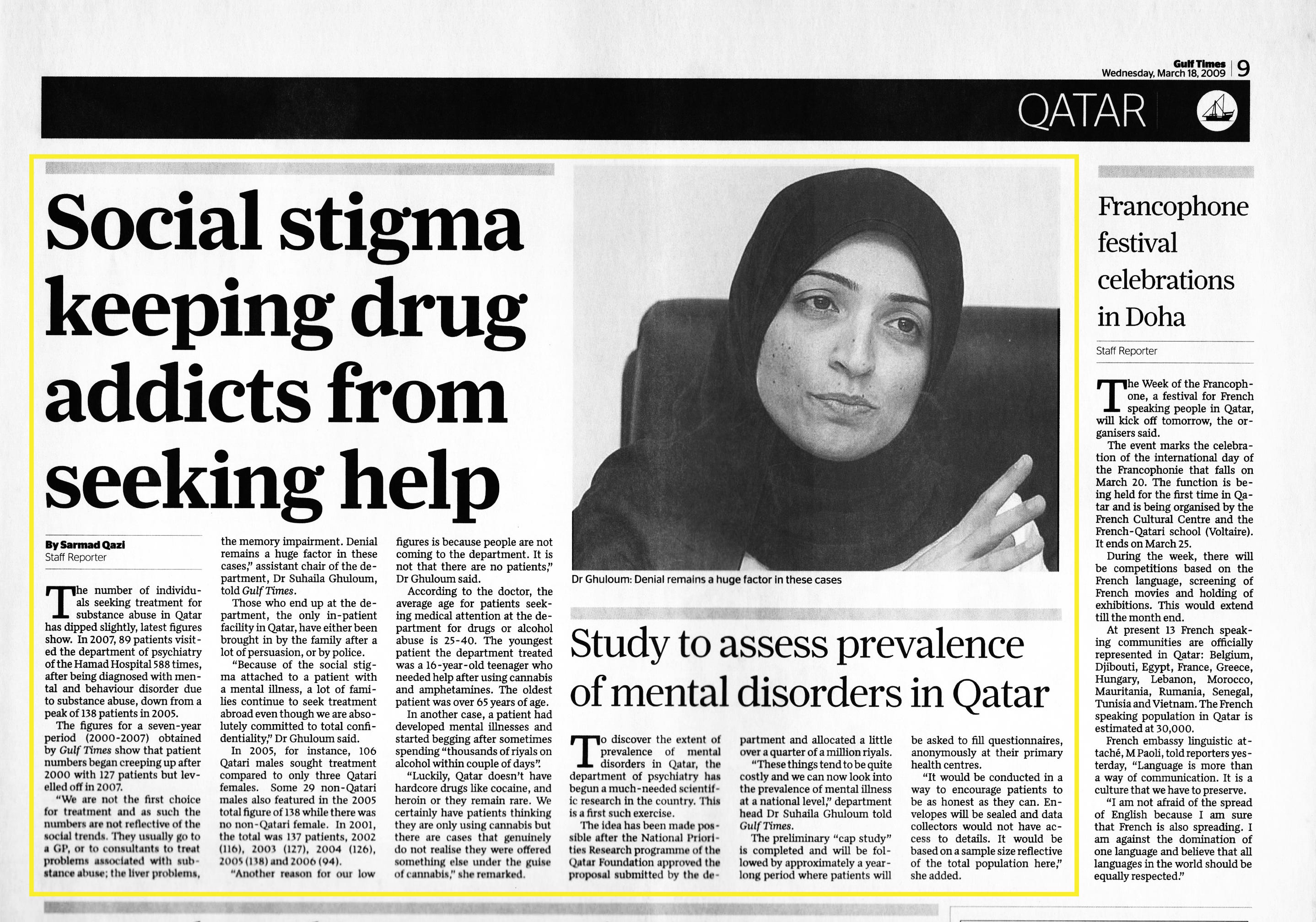
Social stigma keeping drug addicts from seeking help
Originally published in Gulf Times on March 18, 2009
The number of individuals seeking treatment for substance abuse in Qatar has dipped slightly, latest figures show. In 2007, 89 patients visited the department of psychiatry of the Hamad Hospital 588 times, after being diagnosed with mental and behaviour disorder due to substance abuse, down from a peak of 138 patients in 2005.
The figures for a seven-year period (2000-2007) obtained by Gulf Times show that patient numbers began creeping up after 2000 with 127 patients but levelled off in 2007.
“We are not the first choice for treatment and as such the numbers are not reflective of the social trends. They usually go to a GP, or to consultants to treat problems associated with substance abuse; the liver problems, the memory impairment. Denial remains a huge factor in these cases,” assistant chair of the department, Dr Suhaila Ghuloum, told Gulf Times.
Those who end up at the department, the only in-patient facility in Qatar, have either been brought in by the family after a lot of persuasion, or by police.
“Because of the social stigma attached to a patient with a mental illness, a lot of families continue to seek treatment abroad even though we are absolutely committed to total confidentiality,” Dr Ghuloum said.
In 2005, for instance, 106 Qatari males sought treatment compared to only three Qatari females. Some 29 non-Qatari males also featured in the 2005 total figure of 138 while there was no non-Qatari female. In 2001, the total was 137 patients, 2002 (115), 2003 (127), 2004 (126), 2005 (138) and 2006 (94).
“Another reason for our low figures is because people are not coming to the department. It is not that there are no patients,” Dr Ghuloum said.
According to the doctor, the average age for patients seeking medical attention at the department for drugs or alcohol abuse is 25-40. The youngest patient the department treated was a 16-year-old teenager who needed help after using cannabis and amphetamines. The oldest patient was over 65 years of age.
In another case, a patient had developed mental illnesses and started begging after sometimes spending “thousands of riyals on alcohol within couple of days”.
“Luckily, Qatar doesn’t have hardcore drugs like cocaine, and heroin or they remain rare. We certainly have patients thinking they are only using cannabis but there are cases that genuinely do not realise they were offered something else under the guise of cannabis,” she remarked.
Study to assess prevalence of mental disorders in Qatar
To discover the extent of prevalence of mental disorders in Qatar, the department of psychiatry has begun a much-needed scientific research in the country. This is a first such exercise.
The idea has been made possible after the National Priorities Research programme of the Qatar Foundation approved the proposal submitted by the department and allocated a little over a quarter of a million riyals.
“These things tend to be quite costly and we can now look into the prevalence of mental illness at a national level,” department head Dr Suhaila Ghuloum told Gulf Times.
The preliminary “cap study” is completed and will be followed by approximately a year-long period where patients will be asked to fill questionnaires, anonymously at their primary health centres.
“It would be conducted in a way to encourage patients to be as honest as they can. Envelopes will be sealed and data collectors would not have access to details. It would be based on a sample size reflective of the total population here,” she added.
As Published