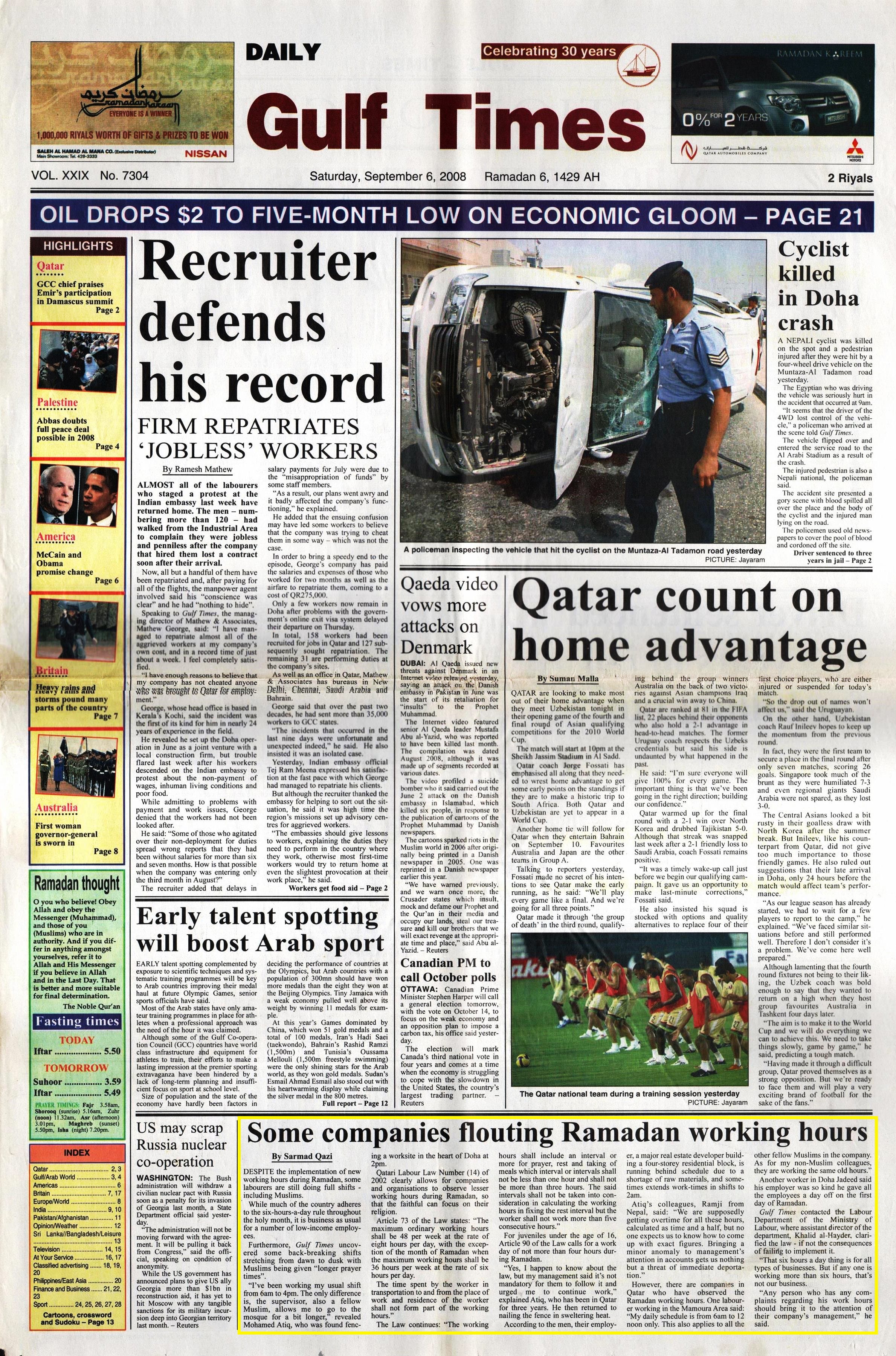
Some companies flouting Ramadan working hours
Originally published in Gulf Times on September 6, 2008
DESPITE the implementation of new working hours during Ramadan, some labourers are still doing full shifts – including Muslims.
While much of the country adheres to the six-hours-a-day rule throughout the holy month, it is business as usual for a number of low-income employees.
Furthermore, Gulf Times uncovered some back-breaking shifts stretching from dawn to dusk with Muslims being given “longer prayer times.”
“I’ve been working my usual shift from 6am to 4pm. The only difference is, the supervisor, also a fellow Muslim, allows me to go to the mosque for a bit longer,” revealed Mohamed Atiq, who was found fencing a worksite in the heart of Doha at 2pm.
Qatari Labour Law Number (14) of 2002 clearly allows for companies and organisations to observe lesser working hours during Ramadan, so that the faithful can focus on their religion.
Article 73 of the Law states: “The maximum ordinary working hours shall be 48 per week at the rate of eight hours per day, with the exception of the month of Ramadan when maximum working hours shall be 36 hours per week at the rate of six hours per day.
The time spent by the worker in transportation to and from the place of work and residence of the worker shall not form part of the working hours.
The Law continues: “The working hours shall include an interval or more for prayer, rest and taking of meals which interval or intervals shall not be less than one hour and shall not be more than three hours. The said intervals shall not be taken into consideration in calculating the working hours in fixing the rest interval but the worker shall not work more than five consecutive hours.”
For juveniles under the age of 16, Article 90 of the Law calls for a workday of not more than four hours during Ramadan.
“Yes, I happen to know about the law, but my management said it’s not mandatory for them to follow it and urged me to continue work,” explained Atiq, who has been in Qatar for three years. He then returned to nailing the fence in sweltering heat.
According to the men, their employer, a major real estate developer building a four-storey residential block, is running behind schedule due to a shortage of raw materials, and sometimes extends work-times in shifts to 2am.
Atiq’s colleague, Ramji from Nepal, said: “We are supposedly getting overtime for all these hours, calculated as time and a half, but no one expects us to know how to come up with exact figures. Bringing in minor anomaly to management’s attention in accounts gets us nothing but a threat of immediate deportation.”
However, there are companies in Qatar who have observed the Ramadan working hours. One labourer working in the Mamoura Area said: “My daily schedule is from 6am to 12 noon only. This also applies to all the other fellow Muslims in the company. As for my non-Muslim colleagues, they are working the same old hours.”
Another worker in Doha Jadeed said his employer was so kind he gave all the employees a day off on the first day of Ramadan.
Gulf Times contacted the Labour Department of the Ministry of Labour, where assistant director of the department, Khalid al-Hayder, clarified the law – if not the consequences of failing to implement it.
“That six hours a day thing is for all types of businesses. But if anyone is working more than six hours, that’s not our business.
“Any person who has any complaints regarding his work hours should bring it to the attention of their company’s management,” he said.
As Published