Top Russian official sees scope for deeper ties
Originally published in Gulf Times on October 5, 2010
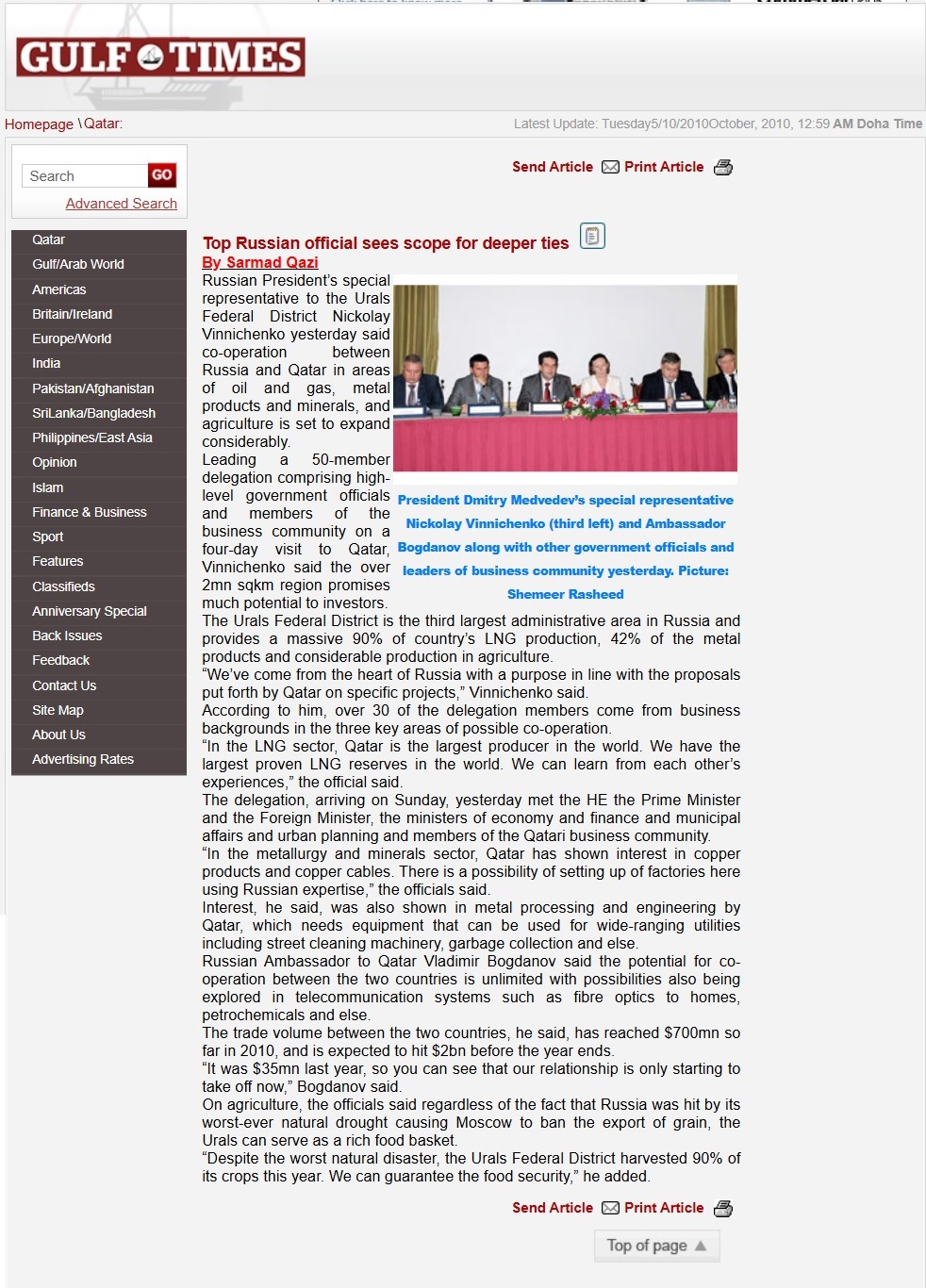
Russian President’s special representative to the Urals Federal District Nickolay Vinnichenko yesterday said co-operation between Russia and Qatar in areas of oil and gas, metal products and minerals, and agriculture is set to expand considerably.
Leading a 50-member delegation comprising high-level government officials and members of the business community on a four-day visit to Qatar, Vinnichenko said the over 2mn sqkm region promises much potential to investors.
The Urals Federal District is the third largest administrative area in Russia and provides a massive 90% of country’s LNG production, 42% of the metal products and considerable production in agriculture.
“We’ve come from the heart of Russia with a purpose in line with the proposals put forth by Qatar on specific projects,” Vinnichenko said.
According to him, over 30 of the delegation members come from business backgrounds in the three key areas of possible co-operation.
“In the LNG sector, Qatar is the largest producer in the world. We have the largest proven LNG reserves in the world. We can learn from each other’s experiences,” the official said.
The delegation, arriving on Sunday, yesterday met the HE the Prime Minister and the Foreign Minister, the ministers of economy and finance and municipal affairs and urban planning and members of the Qatari business community.
“In the metallurgy and minerals sector, Qatar has shown interest in copper products and copper cables. There is a possibility of setting up of factories here using Russian expertise,” the officials said.
Interest, he said, was also shown in metal processing and engineering by Qatar, which needs equipment that can be used for wide-ranging utilities including street cleaning machinery, garbage collection and else.
Russian Ambassador to Qatar Vladimir Bogdanov said the potential for co-operation between the two countries is unlimited with possibilities also being explored in telecommunication systems such as fibre optics to homes, petrochemicals and else.
The trade volume between the two countries, he said, has reached $700mn so far in 2010, and is expected to hit $2bn before the year ends.
“It was $35mn last year, so you can see that our relationship is only starting to take off now,” Bogdanov said.
On agriculture, the officials said regardless of the fact that Russia was hit by its worst-ever natural drought causing Moscow to ban the export of grain, the Urals can serve as a rich food basket.
“Despite the worst natural disaster, the Urals Federal District harvested 90% of its crops this year. We can guarantee the food security,” he added.
As Published