Traffic hit as part of highway caves in
Originally published in Gulf Times on July 2, 2008
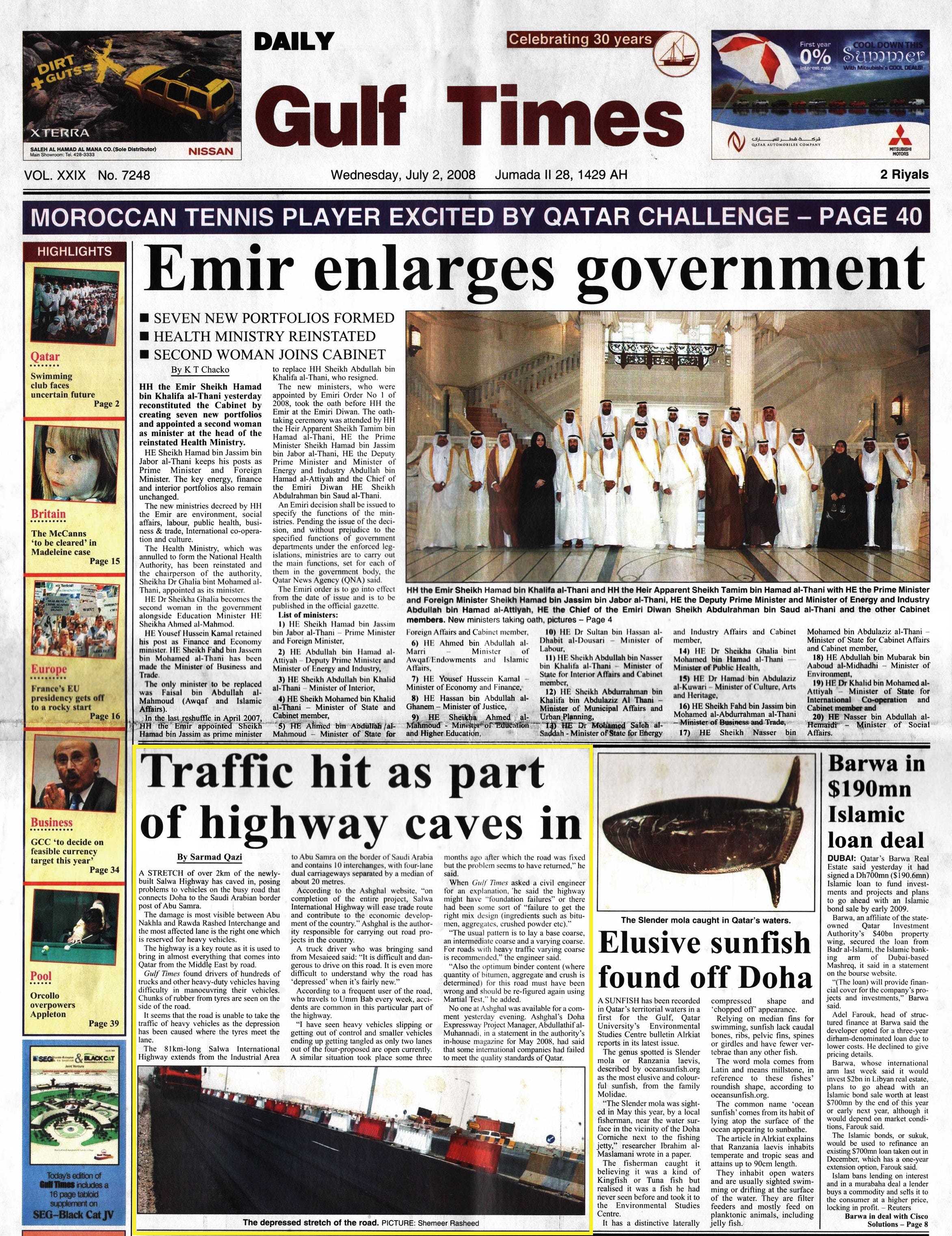
A stretch of over 2km of the newly-built Salwa Highway has caved in, posing problems to vehicles on the busy road that connects Doha to the Saudi Arabian border post of Abu Samra.
The damage is most visible between Abu Nakhla and Rawda Rashed Interchange and the most affected lane is the right one which is reserved for heavy vehicles.
The highway is a key route as it is used to bring in almost everything that comes into Qatar from the Middle East by road.
Gulf Times found drivers of hundreds of trucks and other heavy-duty vehicles having difficulty in manoeuvring their vehicles. Chunks of rubber from tyres are seen on the side of the road.
It seems that the road is unable to take the traffic of heavy vehicles as the depression has been caused where the tyres meet the lane.
The 81km-long Salwa International Highway extends from the Industrial Area to Abu Samra on the border of Saudi Arabia and contains 10 interchanges, with four-lane dual carriageways separated by a median of about 20 metres.
According to the Ashghal website, “on completion of the entire project, Salwa International Highway will ease trade route and contribute to the economic development of the country.” Ashghal is the authority responsible for carrying out road projects in the country.
A truck driver who was bringing sand from Mesaieed said: “It is difficult and dangerous to drive on this road. It is even more difficult to understand why the road has ‘depressed’ when it’s fairly new.”
According to a frequent user of the road, who travels to Umm Bab every week, accidents are common in this particular part of the highway.
“I have seen heavy vehicles slipping or getting out of control and smaller vehicles ending up getting tangled as only two lanes out of the four-proposed are open currently. A similar situation took place some three months ago after which the road was fixed but the problem seems to have returned,” he said.
When Gulf Times asked a civil engineer for an explanation, he said the highway might have “foundation failures” or there had been some sort of “failure to get the right mix design (ingredients such as bitumen, aggregates, crushed powder etc).”
“The usual pattern is to lay a base coarse, an intermediate coarse and a varying coarse. For roads with heavy traffic varying coarse is recommended,” the engineer said.
“Also, the optimum binder content (where quantity of bitumen, aggregate and crush is determined) for this road must have been wrong and should be re-figured again using Martial Test,” he added.
No one at Ashghal was available for a comment yesterday evening. Ashghal’s Doha Expressway Project Manager, Abdullathif al-Muhannadi, in a statement in the authority’s in-house magazine for May 2008, had said that some international companies had failed to meet the quality standards of Qatar.
As Published