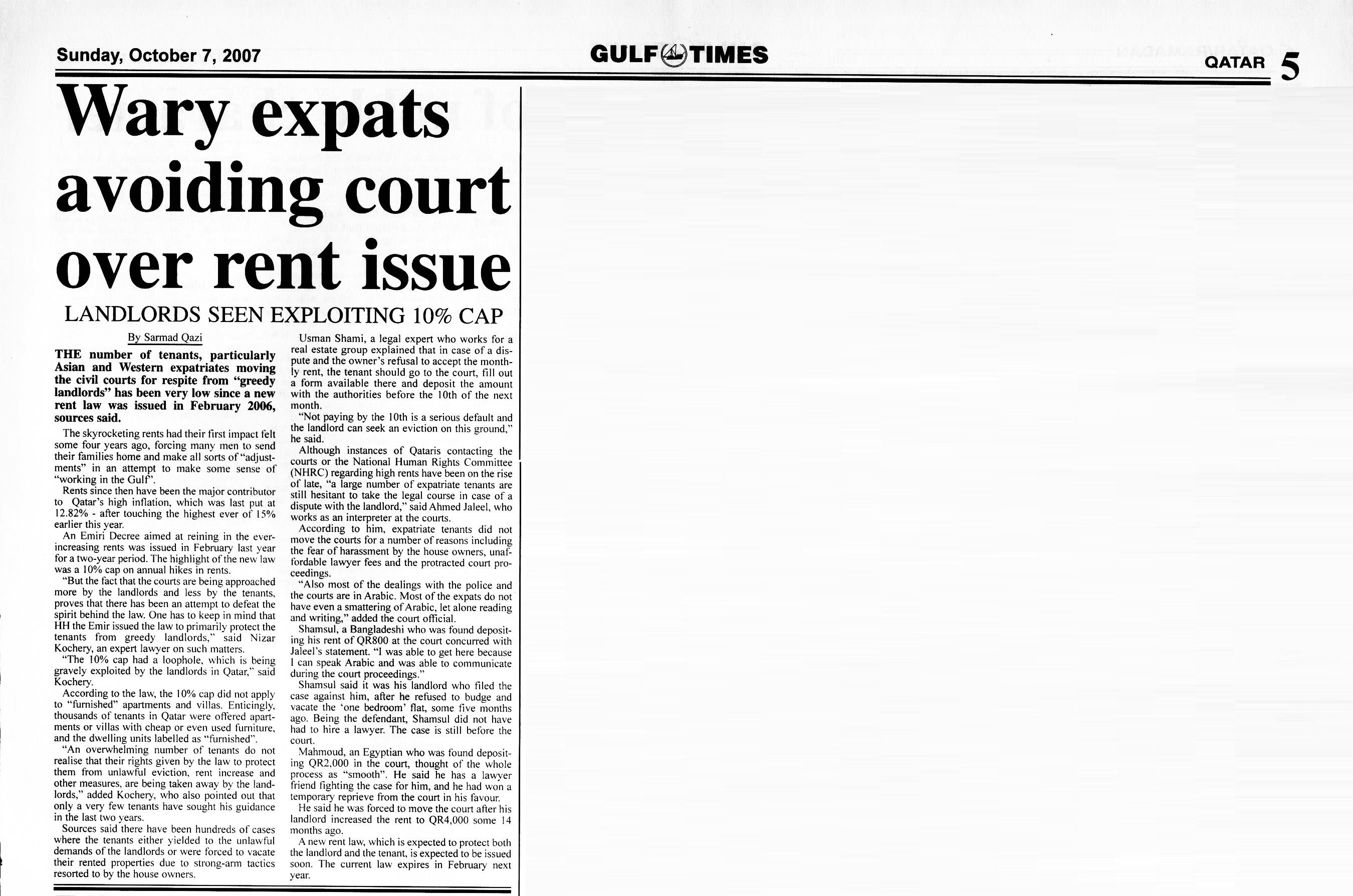
Wary expats avoiding court over rent issue
Originally published in Gulf Times on October 7, 2007
THE number of tenants, particularly Asian and Western expatriates moving the civil courts for respite from “greedy landlords” has been very low since a new rent law was issued in February 2006, sources said.
The skyrocketing rents had their first impact felt some four years ago, forcing many men to send their families home and make all sorts of “adjustments” in an attempt to make some sense of “working in the Gulf”.
Rents since then have been the major contributor to Qatar’s high inflation, which was last put at 12.82% - after touching the highest ever of 15% earlier this year.
An Emiri Decree aimed at reining in the ever-increasing rents was issued in February last year for a two-year period. The highlight of the new law was a 10% cap on annual hikes in rents.
“But the fact that the courts are being approached more by the landlords and less by the tenants proves that there has been an attempt to defeat the spirit behind the law. One has to keep in mind that HH the Emir issued the law to primarily protect the tenants from greedy landlords,” said Nizar Kochery, an expert lawyer on such matters.
The 10% cap had a loophole, which is being gravely exploited by the landlords in Qatar,” said Kochery.
According to the law, the 10% cap did not apply to “furnished” apartments and villas. Enticingly, thousands of tenants in Qatar were offered apartments or villas with cheap or even used furniture, and the dwelling units labelled as “furnished”.
“An overwhelming number of tenants do not realise that their rights given by the law to protect them from unlawful eviction, rent increase and other measures, are being taken away by the landlords,” added Kochery, who also pointed out that only a very few tenants have sought his guidance in the last two years.
Sources said there have been hundreds of cases where the tenants either yielded to the unlawful demands of the landlords or were forced to vacate their rented properties due to strong-arm tactics resorted to by the house owners.
Usman Shami, a legal expert who works for a real estate group explained that in case of a dispute and the owner’s refusal to accept the monthly rent, the tenant should go to the court, fill out a form available there and deposit the amount with the authorities before the 10th of the next month.
“Not paying by the 10th is a serious default and the landlord can seek an eviction on this ground,” he said.
Although instances of Qataris contacting the courts or the National Human Rights Committee (NHRC) regarding high rents have been on the rise of late, “a large number of expatriate tenants are still hesitant to take the legal course in case of a dispute with the landlord,” said Ahmed Jaleel, who works as an interpreter at the courts.
According to him, expatriate tenants did not move the courts for a number of reasons including the fear of harassment by the house owners, unaffordable lawyer fees and the protracted court proceedings.
“Also most of the dealings with the police and the courts are in Arabic. Most of the expats do not have even a smattering of Arabic, let alone reading and writing,” added the court official.
Shamsul, a Bangladeshi who was found depositing his rent of QR800 at the court concurred with Jaleel’s statement. “I was able to get here because I can speak Arabic and was able to communicate during the court proceedings.”
Shamsul said it was his landlord who filed the case against him, after he refused to budge and vacate the ‘one bedroom’ flat, some five months ago. Being the defendant, Shamsul did not have had to hire a lawyer. The case is still before the court.
Mahmoud, an Egyptian who was found depositing QR 2,000 in the court, thought of the whole process as “smooth”. He said he has a lawyer friend fighting the case for him, and he had won a temporary reprieve from the court in his favour.
He said he was forced to move the court after his landlord increased the rent to QR 4,000 some 14 months ago.
A new rent law, which is expected to protect both the landlord and the tenant, is expected to be issued soon. The current law expires in February next year.
As Published