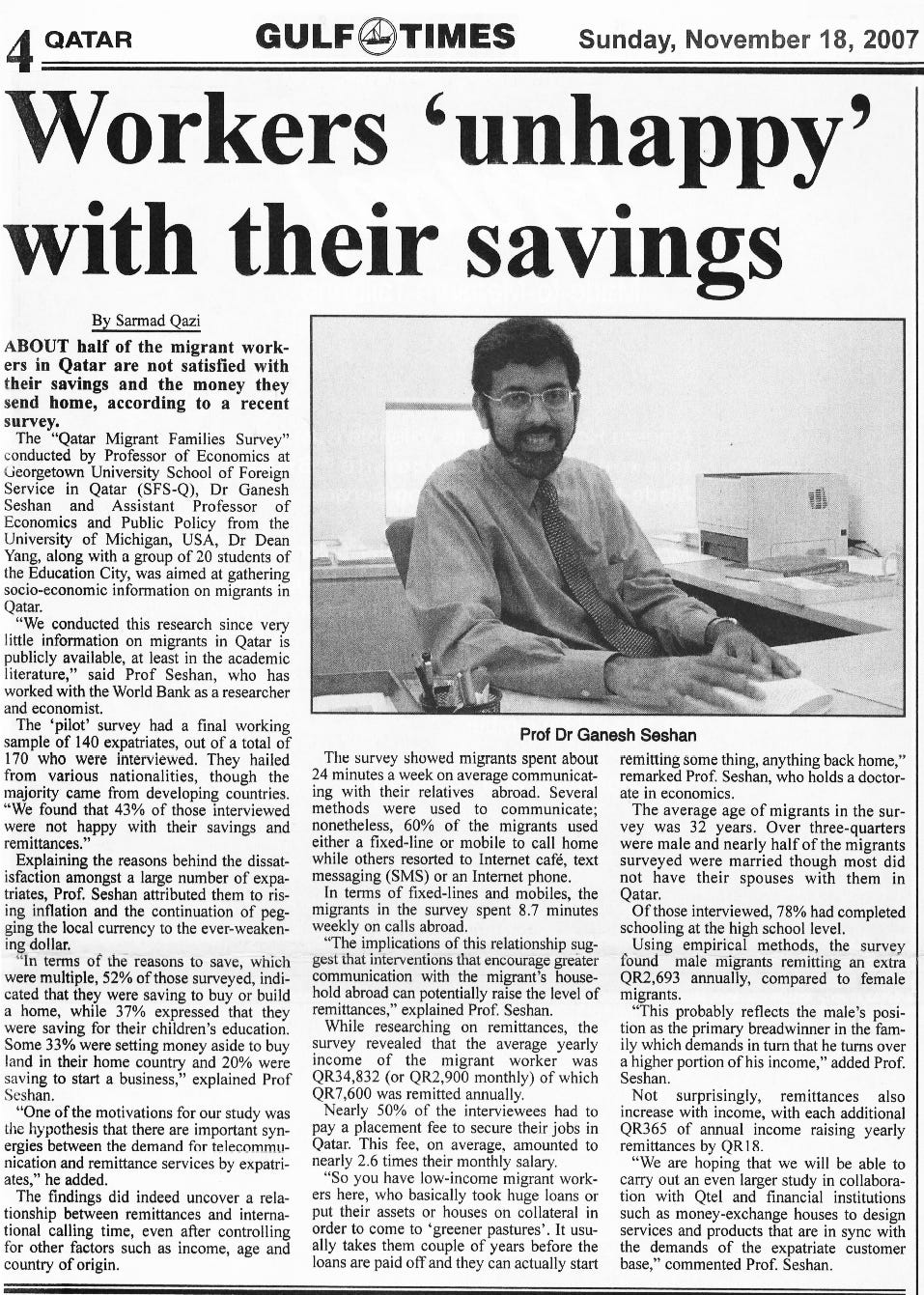
Workers 'unhappy' with their savings
Originally published in Gulf Times on November 18, 2007
ABOUT half of the migrant workers in Qatar are not satisfied with their savings and the money they send home, according to a recent survey.
The “Qatar Migrant Families Survey” conducted by Professor of Economics at Georgetown University School of Foreign Service in Qatar (SFS-Q), Dr Ganesh Seshan and Assistant Professor of Economics and Public Policy from the University of Michigan, USA, Dr Dean Yang, along with a group of 20 students of the Education City, was aimed at gathering socio-economic information on migrants in Qatar.
“We conducted this research since very little information on migrants in Qatar is publicly available, at least in the academic literature,” said Prof Seshan, who has worked with the World Bank as a researcher and economist.
The ‘pilot’ survey had a final working sample of 140 expatriates, out of a total of 170 who were interviewed. They hailed from various nationalities, though the majority came from developing countries. “We found that 43% of those interviewed were not happy with their savings and remittances.”
Explaining the reasons behind the dissatisfaction amongst a large number of expatriates, Prof. Seshan attributed them to rising inflation and the continuation of pegging the local currency to the ever-weakening dollar.
“In terms of the reasons to save, which were multiple, 52% of those surveyed, indicated that they were saving to buy or build a home, while 37% expressed that they were saving for their children’s education. Some 33% were setting money aside to buy land in their home country and 20% were saving to start a business,” explained Prof Seshan.
“One of the motivations for our study was the hypothesis that there are important synergies between the demand for telecommunication and remittance services by expatriates,” he added.
The findings did indeed uncover a relationship between remittances and international calling time, even after controlling for other factors such as income, age and country of origin.
The survey showed migrants spent about 24 minutes a week on average communicating with their relatives abroad. Several methods were used to communicate; nonetheless, 60% of the migrants used either a fixed-line or mobile to call home while others resorted to Internet cafe, text messaging (SMS) or an Internet phone.
In terms of fixed-lines and mobiles, the migrants in the survey spent 8.7 minutes weekly on calls abroad.
“The implications of this relationship suggest that interventions that encourage greater communication with the migrant’s household abroad can potentially raise the level of remittances,” explained Prof. Seshan.
While researching on remittances, the survey revealed that the average yearly income of the migrant worker was QR34,832 (or QR2,900 monthly) of which QR7,600 was remitted annually.
Nearly 50% of the interviewees had to pay a placement fee to secure their jobs in Qatar. This fee, on average, amounted to nearly 2.6 times their monthly salary.
“So you have low-income migrant workers here, who basically took huge loans or put their assets or houses on collateral in order to come to ‘greener pastures’. It usually takes them a couple of years before the loans are paid off and they can actually start remitting something, anything back home,” remarked Prof. Seshan, who holds a doctorate in economics.
The average age of migrants in the survey was 32 years. Over three-quarters were male and nearly half of the migrants surveyed were married though most did not have their spouses with them in Qatar.
Of those interviewed, 78% had completed schooling at the high school level.
Using empirical methods, the survey found male migrants remitting an extra QR2,693 annually, compared to female migrants.
“This probably reflects the male’s position as the primary breadwinner in the family which demands in turn that he turns over a higher portion of his income,” added Prof. Seshan.
Not surprisingly, remittances also increase with income, with each additional QR365 of annual income raising yearly remittances by QR18.
“We are hoping that we will be able to carry out an even larger study in collaboration with Qtel and financial institutions such as money-exchange houses to design services and products that are in sync with the demands of the expatriate customer base,” commented Prof. Seshan.
As Published